Our Pick: Leilo
Check PriceKava Dosage Guide: How Much Kava Should You Drink? (2026)
A typical session lands around 150–250mg of kavalactones, split across shells 15–20 minutes apart — and your first session may do almost nothing, which is normal. Here's the full ladder by format and experience level, with the numbers most dosage guides won't commit to.
By The Kava Review DeskUpdated 2026-08-23~7 min read Ranked by the lab reportHow we research
 Best Value
Koa Kava Vanuatu Waka Kava Powder (8 oz)
Koa Kava · 4.2
$41.99 / 8 oz (1 kg: $124.99) on Amazon
The standard session, by label guidance and long Pacific tradition, totals roughly 150–250 mg of kavalactones, split across two to four servings spaced 15–20 minutes apart. That is a usage norm drawn from tradition and the modern kava community, not a medical dose, and this whole page stays inside that frame. Updated July 2026. Ask "how much kava should I drink?" and most answers retreat into fog: "it depends," "listen to your body," "start slow." All true, all useless without numbers, so here are the numbers the community and the industry have converged on. A traditional shell of medium-strength brew carries somewhere around 150–250 mg on its own depending on how strong it's kneaded; a canned kava drink typically delivers a smaller, fixed amount (check the label, since the honest brands print it); a kava tea bag manages only about 30–50 mg, which is why tea-bag kava chronically underwhelms.
One thing before any of those numbers are useful: kava has a reverse tolerance. Unlike nearly everything else people drink for an effect, kava often does less the first few times you try it, not more. A meaningful share of first-timers feel almost nothing from a textbook session — and the classic rookie error is to "fix" that with a triple dose, which mostly buys you nausea, not bliss. The community's answer is patience: same moderate amount, a few separate evenings, and the effect tends to arrive and then keep getting more reliable. We explain the whole mechanism (as far as anyone understands it) below.
Now the disclaimer, stated plainly because it matters: nothing in this guide is medical advice, and these are not clinical doses. They are usage norms — what Pacific tradition has done for centuries and what the modern community of drinkers, vendors, and kava bars has settled on through long collective experience. Kava is traditionally a some-evenings drink, not an all-day sipper. If you take medications, have liver concerns, are pregnant, or have any health condition, that's a conversation for your doctor, not a review site. What we can do is tell you, with actual numbers, what a sensible session looks like — and where the line is.
The short version
- The community-standard session is roughly 150–250mg of total kavalactones, split across 2–4 servings — these are usage norms from tradition and the community, not medical dosing.
- Kava has a REVERSE tolerance: your first sessions may underwhelm. The fix is patient repetition over several evenings — never chasing it with double or triple doses.
- Space shells 15–20 minutes apart and reassess between each one. Kava creeps; the shell you just drank hasn't finished talking yet.
- An empty-ish stomach (3–4 hours after a meal) is the traditional norm — food noticeably blunts kava, which is the #1 reason sessions 'don't work.'
- Never mix kava with alcohol. Same evening, pick one. This is the least negotiable rule in the entire kava world.
At a glance
| Experience level | Suggested session | In cans | In shells |
|---|---|---|---|
| First-timer | ~100–150mg kavalactones total | 1 can, sipped slowly | 1–2 shells of medium brew, 20 min apart |
| Occasional drinker | ~150–250mg total — the community sweet spot | 1–2 cans across the evening | 2–3 shells, 15–20 min apart |
| Regular (an evening ritual) | ~200–300mg total, rarely more | 2 cans — most regulars graduate to traditional prep | 3–4 shells, paced; stop at relaxed + numb mouth |
| Beyond that | Diminishing returns — community slang: 'krunk' territory | Not the move | More shells ≠ more calm; it buys nausea and a wasted evening |
The session ladder — community usage norms, not medical doses

Leilo Kava Tonic
Leilo
A can is a dose — the label does the math so you don't have to.
Our verdict: For anyone intimidated by strainer bags and milligram arithmetic, Leilo solves dosing by removing it: one can is one fixed, label-stated serving. At about $4.17 a can it's pricier per session than traditional powder, but you cannot accidentally overdo a sealed 12 oz can.
Lab report: Lab-tested kava extract with per-can kavalactone content disclosed by the brand — the disclosure itself is the feature.
The single hardest part of kava for a newcomer isn't the taste (though brace yourself) — it's the measurement problem. Traditional kava strength depends on how many grams you used, how long you kneaded, and how strong the cultivar runs, which means two "shells" can differ by 2x in actual kavalactones. Leilo deletes that entire problem. Each 12 oz sparkling can carries a fixed amount of kava extract with the kavalactone content stated by the brand, so a first-timer's session plan collapses to a sentence: drink one can slowly, wait, see how you feel.
That makes the can the cleanest on-ramp to the ladder above. One can sits comfortably in first-timer territory; an occasional drinker having two across an evening lands inside the community's 150–250mg session norm without ever touching a scale. And because the dose is sealed at the factory, the classic reverse-tolerance mistake — "I feel nothing, let me triple it" — has a physical brake on it: you'd have to deliberately open three more cans, which is a much harder error to make than over-scooping powder.
Is it as strong as a properly kneaded traditional brew? No, and it isn't trying to be. A can is calibrated for a gentle, social-strength serving — exactly what a first or fifth session should be while reverse tolerance sorts itself out. If you work through a 12-pack and find yourself wanting a deeper session, that's your cue to step up to traditional medium-grind kava, not to start pounding cans.
Who should buy it
First-timers, anyone who wants kava without prep or math, and drinkers replacing an evening beer with something they can dose by simply counting cans. It's also the right format for testing whether kava suits you at all before committing to an 8 oz bag and a strainer.
What we don't like
Per-milligram of kavalactones, cans are the most expensive way to drink kava — and a single can may genuinely underwhelm an experienced drinker. The carbonation and flavoring also mean you're tasting a soft drink, not kava, which some traditionalists consider beside the point.
- Format
- 12 fl oz sparkling can, ready to drink
- Serving logic
- One can = one fixed, pre-measured serving
- Kava source
- Kava root extract; kavalactone content disclosed per can
- Price per can
- ≈ $4.17 ($49.99 / 12-pack)
- Best session
- 1 can (first-timer) to 2 cans (occasional)
What we like
- A can IS a dose — zero measurement error possible
- Disclosed kavalactone content; no guessing at strength
- Sealed servings put a physical brake on re-dosing mistakes
- No prep, no strainer bag, no taste of pond water
Worth noting
- Most expensive format per milligram of kavalactones
- Gentle by design — regulars will find one can light
- Flavored and carbonated; this is not the traditional experience
Koa Kava Vanuatu Waka Kava Powder (8 oz)
Koa Kava
Heavy Vanuatu lateral root you dose by the gram, delivered by Amazon; the kilo is the regular's order.
Our verdict: Koa Kava's Vanuatu Waka is the Amazon answer to the same job Kalm's Loa Waka does: a traditional grind where grams and knead time set your strength. At $41.99 for 8 oz it yields roughly 8 to 11 sessions (about $3.80 to $5.25 each), and the 1 kg bag at $124.99 drops that to around $3.50 a session, which is the cheapest traditional math on this page. Waka is the heavy end of the spectrum, so start at the low end of the ladder.
Lab report: Noble-only, origin named on the bag, brand-stated every-batch third-party testing. No public COA or kavalactone percentage, so set your dose by the traditional gram guidance, not a printed number.
Dosing traditional kava is the same arithmetic whatever the bag: roughly 20 to 30 g of root kneaded in a strainer bag for a 2 to 3 shell session, and you adjust up or down by the gram from there. Koa Kava's Vanuatu Waka earns a place on this guide for two practical reasons. It ships from Amazon, and it is sold in a 1 kg bag ($124.99 at our August 2026 check) that brings a traditional session down to about $3.50, the lowest cost per evening of anything here.
Full catalog, origins, and the honest transparency gap are in our Koa Kava review.
Who should buy it
Regulars who have settled their reverse tolerance, prefer a heavier evening profile, and want the best cost per session with Amazon delivery. The kilo is for people who already know they drink kava weekly.
What we don't like
No published COA or kavalactone figure, the same gap as most of the Amazon shelf. Waka's intensity and bitterness make it a poor first bag, and 8 oz pricing is slightly above Kalm's Loa Waka.
- Format
- Traditional grind, 8 oz (≈227 g) or 1 kg bag
- Origin
- Vanuatu Waka, noble lateral root
- Typical prep
- ≈20–30 g kneaded 5–10 min in a strainer bag
- Price per session
- ≈ $3.80–$5.25 (8 oz) · ≈ $3.50 (1 kg)
- Best session
- Start one shell; heavy profile, pace it
What we like
- Lowest cost per traditional session here once you buy the kilo
- Amazon delivery and a real single-origin specialist behind it
- Full control of strength by the gram
Worth noting
- No printed kavalactone percentage
- Heavy, bitter profile, not a first bag

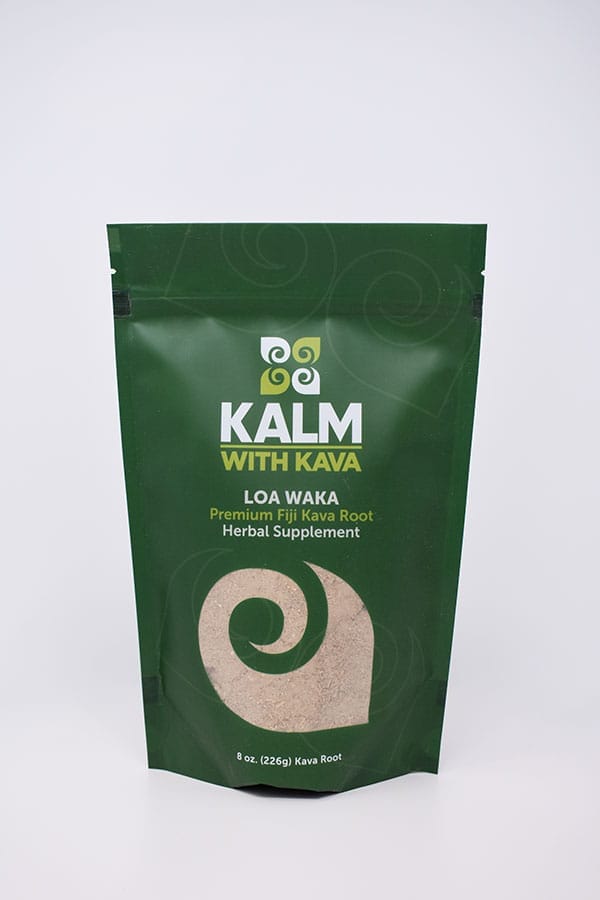
Kalm with Kava — Fiji Loa Waka
Kalm with Kava
A respected Fijian noble cultivar where you control the strength, shell by shell.
Our verdict: Loa Waka is the classic answer once you're past your first sessions: a well-regarded Fijian noble kava in medium-grind form, where grams and knead time set your strength. An 8 oz bag yields roughly 8–11 traditional sessions, which works out to about $3.60–$5.00 per evening — cheaper per session than cans, with far more headroom.
Lab report: Noble-only sourcing with independent lab testing referenced on the product page — verify the current batch before you buy.
Traditional prep is where the session ladder stops being theoretical and becomes something you control. With medium-grind root, you set the dose: a common starting prep is in the neighborhood of 2–4 tablespoons (roughly 20–30g) of powder kneaded in a strainer bag for 5–10 minutes, then portioned into shells you drink 15–20 minutes apart. Want a gentler evening? Use less powder or stop a shell early. Want the full traditional experience once your reverse tolerance has resolved? Knead longer and stronger. No can can do that.
Loa Waka specifically is a strong choice for this job. It's a single-cultivar Fijian noble kava with a long reputation in the community for balanced, relaxing-but-clearheaded sessions — the profile most evening drinkers actually want, as opposed to the heavier, sleepier cultivars. Kalm with Kava sells noble-only kava and references independent lab testing on its product pages, which matters: noble verification is the kava equivalent of a COA, and it's the first thing we check on any traditional powder.
The trade-off is exactly what you'd expect: prep takes ten minutes, the taste is earthy bordering on confrontational, and the measurement responsibility is yours. That last part cuts both ways — the freedom to adjust strength is also the freedom to overdo it, which is why the pacing rules below (shells 15–20 minutes apart, stop at relaxed-plus-numb-mouth) matter most in this format. If you're not sure you're ready for that, start with a pre-measured can and graduate here.
Who should buy it
Drinkers past the first few sessions who want real control over strength and the best cost-per-session math, and anyone who wants kava as a deliberate evening ritual rather than a grab-and-go drink. If your reverse tolerance has resolved and cans now feel light, this is the next rung.
What we don't like
There's a genuine learning curve — knead too briefly and you'll blame the kava for a weak session, scoop too generously and you'll learn what 'krunk' means. The taste is also unapologetically traditional, which is a polite way of saying muddy.
- Format
- Medium-grind dried root, 8 oz (≈227g) bag
- Cultivar
- Loa Waka — single-cultivar Fijian noble kava
- Typical prep
- ≈20–30g kneaded 5–10 min in a strainer bag
- Sessions per bag
- Roughly 8–11 traditional sessions
- Price per session
- ≈ $3.60–$5.00 at ~$39.99/bag
What we like
- Full control of session strength, shell by shell
- Better cost-per-session than any can
- Respected Fijian noble cultivar with a balanced profile
- Noble-only vendor with lab testing referenced
Worth noting
- 10 minutes of prep and a strainer bag required
- Strength varies with your technique — consistency takes practice
- Traditional taste is an acquired tolerance of its own

Primo Kava Kava Capsules (30 ct)
Primo Kava
A Fijian noble extract capsule from a brand that posts a COA, so the dose is a number you can read rather than guess.
Our verdict: If you want dosing with no scale, no strainer, and a lab sheet behind the number, a standardized capsule is the cleanest format, and Primo Kava is the capsule brand on Amazon that actually posts its COAs. The listing states 100 mg per capsule, which puts one to two capsules inside the first-timer rung of the ladder. The catch: the Amazon headline's big extract figures are marketing, so dose from the per-capsule number and the COA, never from the headline.
Lab report: Primo Kava publishes Certificates of Analysis for its products on its own site, the transparency signal we weight most. The Amazon listing now states 100 mg per capsule; confirm the kavalactone figure against the posted COA before you set a dose.
Capsules remove every variable the ladder above warns about: there is no knead time, no gram scale, and no strength drift between batches of your own prep. The trade-off is that you are trusting the label, which is why the only capsule we put on a dosage page is one from a brand that publishes a lab sheet. Primo Kava's capsules are a Fijian noble extract, and the company posts Certificates of Analysis on its site for its products.
We could not pin a stable Amazon price at our August 2026 check, so check the live listing. Our full take, including why we do not repeat the headline milligrams, is in the Primo Kava review; for the wider capsule shelf see best kava capsules.
Who should buy it
Anyone who wants a fixed, repeatable dose with a lab sheet behind it and no prep at all: travellers, office desks, and first-timers who would rather count capsules than shells.
What we don't like
Capsules are slow to land and easy to over-stack while you wait. The Amazon headline milligrams are confusing, and the listing has only a small number of reviews, so it lacks the crowd track record of the bigger capsule brands.
- Format
- Extract capsules, 30 count
- Origin
- Fiji, noble (brand-stated)
- Per capsule
- Listing states 100 mg; confirm on the posted COA
- Transparency
- COAs published on primokava.com
- Best session
- 1 capsule, wait 30–45 min, then reassess
What we like
- Published COA, the rarest thing on the capsule shelf
- Fixed dose, zero prep, travels anywhere
- Fijian noble source named
Worth noting
- Headline milligrams on the listing are confusing
- Slow onset invites stacking; small review count
Pacing a first kava session
- 1
Pick a pre-measured rung
Start with a fixed-dose format — one canned kava, or a single modest shell (about half-strength traditional prep). Target the first-timer rung: roughly 100–150mg of kavalactones for the whole session. Skip alcohol entirely that evening.
- 2
Time it around food
Plan the session for an empty-ish stomach — the community norm is 3–4 hours after your last full meal. Food is the most common reason a first session reports back as 'nothing.'
- 3
Drink, then wait 15–20 minutes
Finish the serving over a few minutes, then stop and wait a full 15–20 minutes before any decision. Kava creeps; the shell you just drank hasn't finished talking yet.
- 4
Read the signals before pouring again
Check for the markers: numb or tingly mouth, loosened shoulders, settled calm. If they're present, you're done — that's the stop rule. If genuinely absent, one more modest serving, then another 15–20 minute wait.
- 5
Cap the session and log it
Two to three servings is a complete first session regardless of effect. If it underwhelmed, that's likely reverse tolerance — the fix is repeating the same moderate session on a few separate evenings, never tripling the dose tonight. Note what you drank and how it landed; the log makes session two smarter.
More kava worth comparing
Beyond this guide: the highest-rated kava across every format, kavalactones verified, with a live price check on each.




As an Amazon Associate we may earn from qualifying purchases, at no cost to you. 21+.
Quick shop: every pick
Skip the scroll: the whole lineup, with a live price check on each.
- Leilo Kava TonicThe Pre-Measured OptionLeilo · $49.99 / 12-packCheck Price
- Koa Kava Vanuatu Waka Kava Powder (8 oz)Cheapest Per Session on Amazon (Traditional)Koa Kava · $41.99 / 8 oz (1 kg: $124.99) on AmazonCheck Price
- Kalm with Kava — Fiji Loa WakaAdjustable Traditional StrengthKalm with Kava · ~$39.99 / 8ozCheck Price
- Primo Kava Kava Capsules (30 ct)Pre-Measured Capsule With a Published COAPrimo Kava · Check the live Amazon listingCheck Price
Key terms
- Shell
- One serving of traditional kava, named for the coconut half-shell it's served in at nakamals and kava bars. A medium-strength shell typically carries on the order of 150–250mg of kavalactones, depending on prep.
- Session
- A full evening's kava — usually 2–4 servings spaced 15–20 minutes apart, totaling roughly 150–250mg of kavalactones for most drinkers. The session, not the single shell, is the unit that matters.
- Reverse tolerance
- Kava's signature quirk: new drinkers often feel little or nothing for the first several sessions, with effects emerging and strengthening through consistent moderate use. The community fix is patient repetition — never escalating doses.
- Kavalactone mg
- The honest unit of kava strength. Grams of root, shells, and cans are all proxies; milligrams of kavalactones — the active compounds — are what the session ladder actually counts. Good brands disclose them.
- Krunk
- Community slang for over-doing it — the heavy, queasy, wobbly state past the point of diminishing returns. Decoded honestly: it's not a goal or a badge, it's the kava community's word for 'you should have stopped two shells ago.'
Questions, answered
How many cans of kava is too many?
Count kavalactones, not cans. Most drinkers' sessions total roughly 150–250mg of kavalactones, so check your can's label and do the math — for many canned kavas that's one to two cans an evening, and a third is usually buying diminishing returns rather than more calm. These are community usage norms, not medical limits; if you have health questions, ask a doctor, not a beverage label.
Should I drink kava on an empty stomach?
Empty-ish, yes — that's the traditional norm. Community guidance typically says 3–4 hours after your last real meal: food noticeably blunts and delays kava, and a full stomach is the most common reason a session 'doesn't work.' The trade-off is that an empty stomach also hits harder and faster, so it pairs with starting modest, and a queasy stomach is your cue to have a light snack rather than power through.
Can I drink kava every day?
Tradition says kava is a some-evenings drink, and that's the framing we trust — in the Pacific it's a deliberate evening ritual, not an all-day sipper, and the modern community broadly mirrors that with a few sessions a week. Daily heavy use is where the community's own cautionary tales live. Whether any frequency is right for your particular body is a medical question, and we're a review site, not your doctor.
Why don't I feel anything from kava?
Three usual suspects, in order: reverse tolerance (first sessions commonly underwhelm — the fix is repeating the same moderate session across several evenings, not tripling tonight's dose), a full stomach (kava 3–4 hours after eating is a different drink than kava after dinner), and an underpowered format (a tea bag's ~30–50mg of kavalactones is a fraction of a real session). Fix those three before concluding kava isn't for you.
Can I mix kava and alcohol?
No — this is the least negotiable rule in kava. Both settle the nervous system and the combination stacks unpredictably; every serious vendor, kava bar, and community resource repeats the same don't-mix guidance. Pick one for the evening. If you've had drinks, kava is for another night, and vice versa.
How long does a kava session last?
Each shell starts reporting in within about 15–20 minutes, and the relaxed plateau from a normal 2–4 shell session typically carries a couple of hours, fading gently rather than crashing. That timeline is exactly why shells are spaced 15–20 minutes apart — drink faster and you're stacking servings before the earlier ones have fully arrived. Plan it like a wind-down: an evening ritual that lands you relaxed, not a quick hit.
Keep reading
How Much Kava Is Too Much?
The ceiling: by format, what crossing it feels like, and how to avoid it.
Kava Capsules vs Powder
How format changes onset and dose control.
What Is Kava?
The plant, the tradition, and what a session actually feels like — the full primer.
What Are Kavalactones?
The active compounds behind every number in this guide, and how to read them on a label.
Kava Reverse Tolerance, Explained
Why your first kava may do nothing — and the patient playbook that actually fixes it.
Best Kava Brands
The brands that disclose their kavalactone numbers, which is what makes honest dosing possible in the first place.