Our Pick: Leilo
Check PriceBest Kava for Beginners (2026): The Easiest Ways to Start
Almost every bad first kava experience comes from the same mistake: starting with a strong traditional brew, then either gagging on the earthy taste or deciding kava "doesn't work" because the first one felt like nothing. Both are avoidable. The best beginner kavas are forgiving, flavored, zero-prep, and honest about the dose — so we ranked the easiest on-ramps in order, from a crack-and-sip can to the gentlest tea, with the one traditional grind worth graduating to once you actually like the stuff.
By The Kava Review DeskUpdated 2026-06-13~7 min read Ranked by the lab reportHow we research
If you have never had kava and you ask the internet where to start, you will mostly be pointed at a bag of loose root and a straining bag — which is roughly like answering "I'd like to try coffee" with "here's a sack of green beans and a roaster." It is the single most common way a first kava goes wrong. A traditional brew is strong, it is famously earthy, and preparing it is a ten-minute kneading-and-straining job that ends in a muddy slurry. Hand that to a curious newcomer and one of two things happens: they can't get it down, or they expect an instant alcohol-style hit, feel nothing, and conclude the whole thing is a scam. Neither outcome has anything to do with whether you'd enjoy kava. They're just the wrong starting line.
So this guide inverts the usual advice. The best kava for a beginner is not the strongest or the most authentic — it's the most forgiving. Specifically: flavored (so the taste isn't a wall), zero-prep (so there's no ritual to fumble), and ideally disclosed-dose (so you know roughly what you're drinking). We ranked five real, in-the-lane products in order of how gentle the on-ramp is, from a flavored can you crack and sip to the lowest-effort thing on the entire shelf — a tea bag — and then, at the bottom, the one traditional grind we'd point you to after you've decided you like kava and want to do it properly. Think of the list as a staircase, not a menu.
Two things to carry into your first session, both covered in full below. First, the taste reality: a flavored can or tea sidesteps it, but you should know going in why traditional kava tastes the way it does (we wrote a whole piece on that). Second, and more important: kava's famous reverse tolerance means your first kava may feel mild or like nothing at all, with the effect showing up more clearly on your second or third try — so do not judge it on night one. As always: adults 21 and up, don't mix kava with alcohol, don't drive on a heavy serving, and none of this is medical advice — effects vary person to person. (Still weighing kava against a daily supplement habit instead? Our kava vs ashwagandha comparison explains which kind of calm each one is for.)
The short version
- The #1 beginner mistake is starting with a strong traditional brew — you either can't get the earthy taste down, or you expect an instant hit and quit before kava's reverse tolerance kicks in.
- The best beginner kavas are forgiving, flavored, zero-prep, and disclosed-dose. We rank them by easiest on-ramp, not by strength or authenticity.
- Our top pick is the Leilo Kava Tonic — a flavored, ready-to-drink can with zero preparation and no acquired-taste hurdle, which makes it the lowest-risk way to find out if kava is for you.
- Expect your first kava to feel mild. Reverse tolerance means many people feel little for the first few sessions, then notice the same amount working — so give it a handful of tries before deciding.
- Once you know you like it, graduate to a named noble traditional grind like Kalm with Kava's Loa Waka. That's the real experience — but it's the finish line, not the starting line.
At a glance
| Pick | Effort | Taste | Strength for a newbie | Price | Check price |
|---|---|---|---|---|---|
| Leilo Kava Tonic (Our Pick) | None — crack & sip | Easy, flavored & sweetened | Light, forgiving | $49.99 / 12-pack (~$4.17/can) | Check Price |
| MELO Sparkling Kava | None — crack & sip | Easy, zero-sugar seltzer | Light–moderate, 100 mg disclosed | $49.99 / 12-pack (~$4.17/can) | Check Price |
| TRU KAVA Tropical Citrus | None — crack & sip | Rootier (real root juice) | Light–moderate, 65–75 mg avg | $29.94 / 6-pack (~$4.99/can) | Check Price |
| Yogi Kava Stress Relief Tea | Minimal — steep a bag | Mild herbal tea | Weakest here, by design | ~$5 / 16-bag box | Check Price |
| Kalm with Kava Loa Waka (graduate to this) | High — knead & strain | Earthy, traditional | Strong, authentic | ~$39.99 / 8oz | Check Price |
The beginner staircase — ranked by easiest on-ramp, not by strength. Prices and disclosures verified against brand pages, June 2026.

Leilo Kava Tonic (Sunset Variety)
Leilo
The most beginner-proof kava there is — flavored, sweetened, zero prep, and cheap enough to treat as an experiment.
Our verdict: Leilo is our top beginner pick because it removes both things that wreck a first kava: the labor and the taste. There's no root to knead, no straining bag, no earthy slurry — you crack a flavored, sweetened can and sip. It's deliberately lighter than a traditional bowl, which is exactly right for finding out whether you like kava, and at roughly four dollars a can the experiment is cheap. Start here.
Lab report: Brand publishes its kava sourcing and ingredient panel; batch documentation available on request. No per-can kavalactone number disclosed — but for a first taste, the controlled, light dose is the point.
If you take one thing from this guide, it's this: your first kava should be a flavored can, and Leilo is the most beginner-proof one on the shelf. Leilo built its entire product around erasing the two barriers that scare newcomers off real kava — the ten-minute preparation and the famously earthy taste of a traditional brew. The Sunset variety tonic shows up flavored, sweetened, cold-and-ready in a single-serving can. No ritual to get wrong, no taste wall to climb.
We'll be straight about expectations, partly because of reverse tolerance: a light can on night one may feel like very little, and that is completely normal — not a sign the product is weak or that kava "doesn't work on you." Drink one, give it 20 to 30 minutes, notice the mild tongue tingle and the easing of tension, and pay more attention to sessions two and three than to the first. (For the full arc of onset, plateau, and how long it runs, see how long kava lasts.) Leilo's broad, fruity flavor range (and a sugar-free mocktail line) also makes it the easy can to keep around while you figure out whether kava earns a spot in your evenings. Curious how it compares to a documented Fijian shot brand? Our Taki Mai vs Leilo head-to-head covers exactly that. Adults 21+, no alcohol, no driving on a heavy serving.
Who should buy it
Buy this if you're kava-curious and want the single lowest-effort, lowest-risk way to feel what kava does — no preparation, no acquired-taste hurdle, and a per-can price low enough to treat as a one-time experiment. It's the obvious first purchase for almost anyone who has never had a shell, and the can we'd hand to a table of total first-timers.
What we don't like
By design it's lighter than a traditionally prepared bowl, so a seasoned drinker chasing a strong, classic session will find it underpowered — that's the trade for the convenience. It's also a sweetened packaged beverage rather than pure root-and-water kava, and Leilo discloses extract weight rather than a kavalactone number, so you don't know your exact dose (less critical for a first taste than for a value comparison).
- Format
- Ready-to-drink canned tonic — zero preparation
- Variety
- Sunset (flavored, sweetened)
- Pack
- 12-pack
- Per-serving price
- ~$4.17 / can
- Dose disclosure
- Extract weight only (no kavalactone number) — light by design
What we like
- Zero preparation — the most beginner-proof kava format there is
- Flavored and sweetened, so it skips the challenging traditional taste entirely
- Light, forgiving dose — hard for a first-timer to overdo
- 12-pack pricing keeps a first experiment cheap per serving
Worth noting
- Lighter than a traditional bowl — underpowered for veterans
- A sweetened packaged beverage, not pure root-and-water kava; no kavalactone number disclosed

MELO Sparkling Kava
MELO
The beginner can for people who want a number — 100 mg of kavalactones stated plainly, zero sugar, crack and sip.
Our verdict: MELO is the beginner pick for the type who reads labels. It's a zero-sugar sparkling can with no preparation, and — unusually — it tells you the dose: 100 mg of kavalactones per 12 oz can, stated flat. That means your first kava comes with a known quantity instead of a mystery, which is reassuring when you're calibrating. Tropical, seltzer-style, and the same easy on-ramp as our top pick, with a number attached.
Lab report: Discloses 100 mg of kavalactones per can — the cleanest potency number in the category — and claims Vanuatu farm-sourced kava with lab testing. We'd still like a public, downloadable COA library.
If "how much am I actually drinking?" is the question keeping you from trying kava, MELO is your starter. MELO is a zero-sugar, zero-calorie sparkling kava can with the same crack-and-sip simplicity as any RTD — but it does the one thing most of the category won't: it prints the dose. Each 12 oz can states 100 mg of kavalactones, sourced from kava root the brand says it grows on its own farm in Vanuatu. For a newcomer, a disclosed number turns a vague first try into a controlled one.
As a drink it lands in the modern seltzer register — tropical, lightly sweet (with no sugar), adult. The flavor range is narrower than Leilo's, and a $19.99 four-pack makes the trial cheap. The same first-session rules apply: give it 20 to 30 minutes, expect the mild tongue tingle, and don't read too much into night one thanks to reverse tolerance. The one thing we'd still ask of MELO is a public COA library — the 100 mg label claim is excellent, but downloadable batch paperwork would make it bulletproof. Adults 21+, no alcohol, no driving on a heavy serving.
Who should buy it
Buy MELO as your first kava if you like knowing your numbers — it's the rare beginner can that states a flat kavalactone dose (100 mg), so you can calibrate your tolerance against a known quantity instead of a guess. It's also the right call for the zero-sugar crowd who want the easy on-ramp without the cane sugar some flavored cans carry.
What we don't like
The flavor lineup is only three deep and all tropical-leaning, so it's less of a crowd-pleaser at a mixed table than Leilo. And while the 100 mg disclosure is the best label in the category, MELO doesn't yet post a public, downloadable COA library — we want the batch sheets, not just the claim.
- Format
- Ready-to-drink sparkling can — zero preparation
- Dose disclosure
- 100 mg kavalactones per can (stated plainly)
- Sweetener
- Zero sugar, zero calories
- Source
- Kava root from the brand's farm in Vanuatu (per the brand)
- Pack pricing
- $19.99/4-pack · $49.99/12-pack (~$4.17/can)
What we like
- States a flat 100 mg kavalactone dose — rare clarity for a beginner
- Sensible light-to-moderate single serving; easy to pace
- Zero sugar, zero calories, crack-and-sip simple
- $19.99 four-pack makes the first try low-commitment
Worth noting
- Only three flavors, all tropical — less of a crowd-pleaser than Leilo
- No public, downloadable COA library yet to back the label

TRU KAVA Tropical Citrus
TRU KAVA
The lowest single-can entry price, built from actual kava root juice — a slightly rootier first taste at about $5.
Our verdict: TRU KAVA is the cheapest way onto the staircase at about $5 a can, and the only beginner pick here built from real kava root juice rather than an extract. That makes it a touch rootier and more authentic-tasting than the seltzers above — a small step toward the traditional flavor without leaving the crack-and-sip world. It publishes a 65–75 mg kavalactone average too, so you're not flying blind. A great-value first taste for the slightly more adventurous.
Lab report: Publishes a 65–75 mg kavalactone average per serving and claims every batch is third-party tested for all known contaminants; per-batch COAs aren't posted publicly.
For the lowest-cost entry that still drinks closer to "real" kava, this is the can. The first ingredient on TRU KAVA Tropical Citrus is kava root juice — pressed kava, not extract — carbonated, naturally sweetened with stevia and monk fruit, and flavored with pineapple. TRU KAVA also publishes a potency figure: its traditionally prepared products average 65–75 mg of kavalactones per serving. So you get a real, checkable dose range and the lowest single-can sticker in this guide.
One logistics note from our price check: TRU KAVA sells direct in the continental US only, and the site pushes subscription checkout hard — confirm you've chosen a one-time order before you pay. Same first-session rules as the rest: 20–30 minutes, expect the tingle, and don't write kava off on night one. Adults 21+, no alcohol, no driving on a heavy serving.
Who should buy it
Buy TRU KAVA if you want the cheapest single-can entry (~$5) and you're a little adventurous about taste — it's the only beginner pick made from actual kava root juice, so it previews the real, rootier flavor while staying a no-prep can. It's the value-minded first taste, and a smart bridge for someone who already suspects they'll want to graduate to traditional kava.
What we don't like
The root-juice base makes it earthier than the sweet seltzers above, which a flavor-sensitive first-timer may find less inviting. The 65–75 mg figure is a brand-wide average rather than a per-batch number, the COAs behind the testing claim aren't posted, and the subscription-forward checkout requires attention so you don't accidentally start a recurring order.
- Format
- Ready-to-drink can, kava root juice base — zero preparation
- Dose disclosure
- 65–75 mg kavalactones (published brand average per serving)
- Sweeteners
- Stevia and monk fruit — no sugar, no artificial sweeteners
- Per-can price
- ~$4.99 (lowest single-can entry here)
- Shipping
- Continental US only; subscription-forward checkout
What we like
- Lowest single-can entry price in the guide (~$5)
- Built from actual kava root juice — a more authentic first taste
- Publishes a real kavalactone average (65–75 mg per serving)
- Gentle preview of traditional flavor without any preparation
Worth noting
- Earthier than the sweet seltzers — less inviting for the flavor-sensitive
- Potency is a brand average, COAs aren't posted, and checkout pushes subscriptions
Yogi Kava Stress Relief Tea
Yogi Tea
The lowest-stakes, lowest-cost way to dip a toe in — a mild herbal tea bag, and we're honest that it's weak.
Our verdict: If even a can feels like too much commitment, a kava tea bag is the gentlest toe-dip there is — steep it like any tea, sip something warm and mild, and see if the category appeals at all. We'll be honest: this is the weakest thing in the guide by a wide margin. It's a soothing herbal blend with kava in the mix, not a real kava serving, and you should not judge kava's actual character by it. But at about five dollars a box, it's the cheapest, friendliest first contact you can buy.
Lab report: A mainstream herbal tea blend with kava among its botanicals, sold in standard grocery channels; it is not a potency product and discloses no kavalactone figure.
For the truly tentative, the lowest rung on the staircase is a tea bag. Yogi's Kava Stress Relief is a mainstream herbal tea — kava blended with other calming botanicals like carob and sarsaparilla — sold right next to the chamomile at the grocery store. You steep a bag in hot water and drink something warm, mild, and faintly sweet. There is no preparation beyond boiling water, no earthy slurry, and no real risk of overdoing anything.
Where this earns its spot is friction and price: it's the cheapest, most available, most no-pressure way to encounter kava at all, and it doubles as a pleasant bedtime tea regardless. If the cup intrigues you, step up to one of the cans above for an honest light dose, and remember reverse tolerance means the real picture only emerges over a few proper sessions. Standard cautions still apply even at this gentle level: adults 21+, don't combine kava with alcohol, and not medical advice.
Who should buy it
Buy a box of kava tea if you want the absolute lowest-stakes, lowest-cost way to dip a toe in — no can to commit to, no preparation, just a warm, mild cup from the grocery store. It suits the deeply cautious first-timer and anyone who'd rather meet the idea of kava as a bedtime tea before deciding whether to try a proper serving.
What we don't like
It's weak — easily the mildest thing here — and that's the whole catch: it can leave a newcomer thinking kava does nothing, when really they just haven't had a real serving yet. It's a multi-botanical blend rather than straight kava, with no kavalactone disclosure, so it's a toe-dip and a flavor preview, not a fair test of the plant.
- Format
- Herbal tea bags — steep in hot water
- Dose disclosure
- None — a botanical blend, not a potency product
- What's inside
- Kava blended with other calming botanicals
- Availability
- Mainstream grocery and online
- Per-box price
- ~$5 / 16 bags (cheapest entry here)
What we like
- The gentlest, lowest-stakes first contact with kava there is
- Cheapest entry in the guide and widely available at grocery stores
- No preparation, no risk of overdoing it, pleasant as a bedtime tea
Worth noting
- By far the weakest kava experience here — easy to wrongly conclude kava does nothing
- A multi-botanical blend with no kavalactone disclosure — not a fair test of real kava

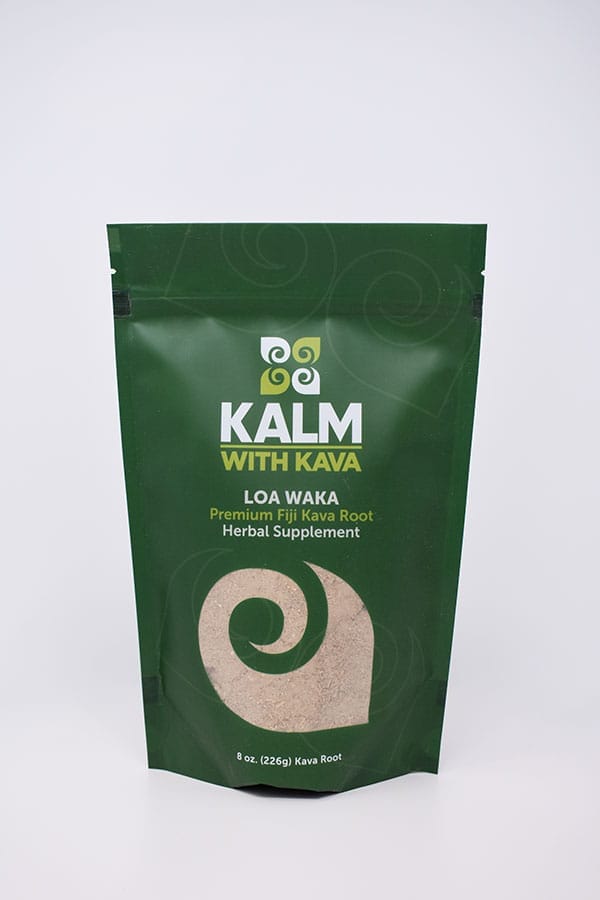
Kalm with Kava — Fiji Loa Waka (Traditional Grind)
Kalm with Kava
Not a beginner kava — the graduation pick. A named noble Fijian root for once you know you like it and want the real thing.
Our verdict: This is the finish line, not the starting line — we include it so you know where the staircase leads. Once a can or two has told you that you genuinely like kava, Loa Waka is where you go to drink it the way the islands actually do: a named, single-origin Fijian noble root, prepared by hand. It's more effort and a stronger, earthier experience than any can, and it's the closest most people in the US will get to a real bowl. Graduate to it; don't start with it.
Lab report: Noble Fijian cultivar from a long-running kava specialist; the brand details origin and preparation. Confirm the current lot on the product page.
Every staircase needs a top step. This is ours — and the explicit warning is that it's the wrong place to begin. Where a flavored can erases the ritual, a traditional grind is the ritual, and Kalm with Kava is a long-running specialist that sources named, single-origin Pacific cultivars for drinkers who've decided they want the genuine article. Loa Waka is a well-regarded Fijian noble variety — the daily-drinking class of cultivar the islands prize — ground to be prepared the traditional way rather than poured from a can.
The reason it sits last isn't quality — it's sequencing. Loa Waka being an explicitly noble cultivar matters a great deal (noble kavas are the smooth daily-drinking varieties, the opposite of the harsh "tudei" roots to avoid), and from a specialist this is a genuinely excellent bag of root. But it asks more of you than a can does, and the right time to buy it is after the cans have already sold you on kava. When that day comes, this 8oz bag is the honest next step. Same rules, more so at this strength: adults 21+, no alcohol, no driving, and start with a single modest shell.
Who should buy it
Buy this once — and only once — you already know you like kava and want to drink it the way it's actually drunk in the Pacific: a named, single-origin noble cultivar prepared by hand. It's the right graduation pick for the drinker ready to trade convenience for authenticity and a stronger, fuller serving. If you've never had kava, start with our top-pick can instead and come back to this.
What we don't like
It is genuine work — kneading and straining every serving is messier and slower than cracking a can — and the earthy, traditional taste is an acquired one a first-timer likely isn't ready for. The strength is also less forgiving, so it's easy to overdo when you're new, which is the entire reason we route beginners through cans first and rank this last.
- Format
- Traditional grind (knead & strain) — high effort
- Origin
- Fiji — single origin
- Cultivar
- Loa Waka (noble)
- Size
- 8oz
- Best for
- Graduating after you already enjoy kava — not a first kava
What we like
- A named, single-origin noble Fijian cultivar — the real quality article
- Traditional preparation delivers the authentic, fuller experience
- You control the strength of every batch
- From a long-running kava specialist, not a generic reseller
Worth noting
- Real effort and an acquired, earthy taste — wrong as a first kava
- Stronger and less forgiving; easy to overdo when you're new
More kava worth comparing
Beyond this guide: the highest-rated kava across every format, kavalactones verified, with a live price check on each.



As an Amazon Associate we may earn from qualifying purchases, at no cost to you. 21+.
Quick shop: every pick
Skip the scroll: the whole lineup, with a live price check on each.
- Leilo Kava Tonic (Sunset Variety)Easiest First KavaLeilo · $49.99 / 12-pack (~$4.17/can)Check Price
- MELO Sparkling KavaThe Disclosed-Dose StarterMELO · $49.99 / 12-pack (~$4.17/can)Check Price
- TRU KAVA Tropical CitrusCheapest Entry Per CanTRU KAVA · $29.94 / 6-pack (~$4.99/can)Check Price
- Yogi Kava Stress Relief TeaThe Gentlest Possible Toe-DipYogi Tea · ~$5 / 16-bag boxCheck Price
- Kalm with Kava — Fiji Loa Waka (Traditional Grind)When You're Ready to GraduateKalm with Kava · ~$39.99 / 8ozCheck Price
How we chose
We ranked for the on-ramp, not the ceiling. The whole point of a beginner guide is the opposite of an enthusiast guide: the best first kava is the one most likely to give a curious newcomer a pleasant, low-stakes, repeatable experience — which means we weighted forgiveness over strength and authenticity over nothing. Effort (is there preparation?), taste (flavored and approachable, or earthy and challenging?), and dose-forgiveness (light enough that a first-timer can't easily overdo it) drove the order. The strongest, most authentic option in this guide is ranked last on purpose.
We favored disclosed dose and stayed in the legally-sellable, verifiable lane. Where a brand states an actual kavalactone number — like MELO's 100 mg per can — we say so, because a newcomer benefits from knowing roughly what they're drinking. Every price, pack size, and label claim below was checked against the brand's own product page in June 2026; we did not invent potency figures, run a fake tasting panel, or estimate numbers a brand declined to publish. Two of these picks disclose a real kavalactone figure; the others we describe honestly by format and the brand's own wording.
We judged each as a first kava, in plain experiential terms — and kept it lawful. Kava is a centuries-old Pacific social drink that many adults find relaxing; it is not a treatment for anything, it can cause drowsiness, and we make no health claims. Our notes describe taste, effort, and the kind of gentle, sociable calm drinkers consistently report — never a promised effect on your body. Adults 21+, no alcohol, no driving on a heavy serving, and if you take medications or have a liver condition, talk to your doctor first. None of this is medical advice.
Key terms
- Reverse tolerance
- Kava's well-documented quirk in which many newcomers feel little or nothing for their first few sessions, then find the SAME amount suddenly works once the body has had some exposure — the opposite of how tolerance usually builds. It is the single most common reason a first-timer wrongly concludes kava does not affect them, and the reason you should never judge kava on night one.
- Shell
- The traditional serving unit of kava — one bowlful, historically drunk from a half coconut shell, which is where the word comes from. In a kava bar you order kava 'by the shell,' and it's the practical unit for pacing a beginner: have one, wait, see how it sits, then decide on the next rather than front-loading.
- Noble kava
- The class of kava cultivars the South Pacific has selected over centuries for clean, balanced, pleasant daily drinking — the varieties you want. The opposite is 'tudei' kava, a coarser class associated with heavier, lingering next-day effects. When you graduate to loose root, buying explicitly noble, single-origin kava (like our graduation pick) is the most important quality decision you'll make.
- Micronized
- Kava root milled so finely you can stir it straight into water and drink it — pulp and all — without the kneading-and-straining of a traditional grind. It's a common middle step between cans and full traditional preparation: most of the strength, far less of the mess, though the texture is grittier and the taste is still very much kava.
Questions, answered
What kava should a beginner buy?
Start with a flavored, ready-to-drink can — it removes the two things that wreck most first kavas: the ten-minute preparation and the earthy traditional taste. Our top beginner pick is the Leilo Kava Tonic, a flavored, sweetened, zero-prep can that's light enough to be forgiving and cheap enough (~$4 a can) to treat as an experiment. If you want a stated dose, MELO Sparkling Kava discloses 100 mg of kavalactones per can; if you want the cheapest entry with a slightly more authentic taste, TRU KAVA runs about $5 a can on real kava root juice. What you should NOT buy first is a bag of traditional loose root — that's the graduation step, not the starting line.
Will I feel it the first time?
Maybe not — and that's normal. Because of kava's well-known reverse tolerance, many newcomers feel little or nothing from their first one or two sessions, then notice the same amount working once their body has had some exposure. So if your first can is a non-event, it does not mean the kava is weak or that 'it doesn't work on you.' The fix is simple: give any kava a handful of sessions before you judge it, and don't chug three cans on night one trying to force a feeling. The relaxation, when it arrives, is a gentle, sociable calm over 20–30 minutes — not a sudden alcohol-style hit.
Does kava taste bad?
Traditional kava is famously earthy — muddy, peppery, slightly bitter, with a tongue-numbing tingle — and a lot of first-timers struggle with it. That's exactly why our beginner picks are flavored: a sweetened, fruit-flavored can or a mild herbal tea sidesteps the earthiness almost entirely, so you get acquainted with how kava feels before you have to make peace with how it tastes. If you do drink something earthier (or graduate to traditional grind later), the tricks are to drink it fast rather than sip, chase it with juice or fruit, and serve it cold. We break the taste down in full in our guide to what kava tastes like.
How much kava should I start with?
Keep your first serving small — one can, or a single modest shell of loose root, not three. Kava's effect builds gradually and your tolerance is unknown, so the goal of session one is to meet the plant, not to chase a strong experience. With a light beginner can like our picks this is easy: have one, give it 20 to 30 minutes, and see how it sits before deciding on another. Resist the night-one urge to double or triple up to 'force' a feeling — between reverse tolerance and the gentle, building nature of the effect, that just turns a pleasant introduction into a sleepy, heavy one. Adults 21+, no alcohol, and not medical advice.
Can I get hooked on kava?
Kava is generally regarded as non-addictive in the way that word is usually meant — it's a traditional social drink, not a habit-forming substance, and drinkers don't report the cravings or escalating-dose pattern associated with addictive substances (kava's reverse tolerance actually runs the opposite direction at the start). That said, 'non-addictive' isn't the same as 'consume without limits,' and we're reviewers, not doctors. We cover the question in full — including what the record does and doesn't show — in our piece on whether kava is addictive (/journal/is-kava-addictive). As always: adults 21+, don't mix kava with alcohol, keep amounts sensible, and talk to your doctor if you take medications. None of this is medical advice.
What's the best cheap kava starter?
For the lowest entry cost, two options stand out. The cheapest first contact of all is a box of kava tea like Yogi's Kava Stress Relief — about $5 for 16 bags — but be warned it's a mild herbal blend, by far the weakest option here, so don't judge real kava by it. The best cheap actual kava drink is TRU KAVA at roughly $5 a single can, built from real kava root juice with a published 65–75 mg kavalactone average. If you'd rather buy in a pack, both Leilo and MELO run about $4.17 a can in a 12-pack, and MELO offers a $19.99 four-pack for a low-commitment trial. Start cheap, start light, and don't judge it on night one.
Keep reading
What Is Kava?
The complete primer — the root, the kavalactones, the culture, the formats, and what a session actually feels like.
Kava Reverse Tolerance
Why your first kava may feel like nothing — and the one thing that keeps beginners from quitting too early.
Best Kava Drinks
The full ready-to-drink can shelf, ranked on cost per 100 mg of kavalactones with the math shown.