Our Pick: Leilo
Check PriceKava Cocktail & Mocktail Recipes (2026): 7 Ways to Actually Enjoy It
Kava's earthy, muddy-water taste is the single biggest reason people try it once and quit — and it's also a completely solvable problem. These seven recipes don't just hide the flavor; they turn kava into a legitimate, zero-proof cocktail base: a creamy Kava Colada, a cold-brew espresso-martini mocktail, a tropical spritz from a can, a warm golden latte, a kava Moscow mule, a berry refresher, and the purist's Traditional-Plus. Real ingredients, real measurements, each built on a kava you can actually buy. No alcohol, no health claims — just the drinks that make kava something you look forward to.
By The Kava Review DeskUpdated 2026-07-26~8 min read Ranked by the lab reportHow we research
The answer up front: kava's muddy-water taste is a solvable logistics problem, and these seven zero-proof recipes solve it three ways: chase it, build around coconut and citrus, or start from a flavored can engineered to taste like a soft drink. Start with the Kava Colada, our flagship, where coconut fat rounds the root's earthy edges and pineapple juice doubles as the classic kava-bar chaser, built right into the glass. Updated July 2026. Here is the quiet tragedy these recipes exist to fix: most people who quit kava never disliked what it did. They disliked how it tasted. Kava is root tea, earthy, peppery, faintly bitter, with a silty texture nearly everyone independently calls muddy water, and that flavor is the number-one barrier between a curious first-timer and a regular evening habit.
There's a second, bigger reason to care about kava recipes right now: the sober-curious moment is real, and kava is one of the only botanicals that can carry an actual cocktail. It pours, it mixes, it has body, and it gives you something to do with your hands at 9 p.m. that isn't pouring wine. A well-built kava drink isn't a sad consolation mocktail — it's a creamy colada, a cold-brew nightcap, a citrus spritz that looks like a real drink in a real glass. The recipes below are designed to stand on their own at a dinner party, no apology required.
Every recipe here is built on a specific kava you can buy, because a recipe you can't shop is just a daydream. We use four bases — a flavored can, a sparkling can with a disclosed dose, a traditional Fiji root for the brews, and a no-strain instant for speed — and we tell you which to reach for and why. Three house rules run through all of it, and they're not optional. Don't boil your kava (heat wrecks it — more on that below). Don't add alcohol (here's why that's a hard no: kava and alcohol). And know your dose — these are evening drinks, kava has a real reverse-tolerance curve, and our dosage guide covers how to pace a session. Kava is 21-and-up, the tongue-tingle is normal, and nothing here is medical advice.
The short version
- The taste is the barrier, and these recipes are the fix — ranked the way kava bars actually do it: chase it, build around coconut/citrus, or start from a flavored can that's engineered to taste like a soft drink, not a riverbed.
- Kava is a genuine alcohol-free cocktail base. It has body, it mixes, and it gives the sober-curious a real drink instead of a sad mocktail — a colada, a spritz, a cold-brew nightcap that holds up at a dinner party.
- Never boil kava. Heat above ~140°F degrades kavalactones and turns the root's starch to sludge; warm-serve recipes top out at bathwater-warm (100–110°F), and you build hot lattes by warming the OTHER ingredients, not the kava.
- Never add alcohol to kava — it's the one mixing rule with no exceptions (see our kava-and-alcohol guide). Every recipe here is zero-proof on purpose, and that's a feature.
- Match the base to the effort you want: cans (Leilo, MELO) for a 2-minute spritz, traditional root (Loa Waka) for the creamy/warm builds where body matters, instant (Root of Happiness) when you want strength without a strainer bag.
At a glance
| Recipe | Base product | Prep | Vibe |
|---|---|---|---|
| Kava Colada (flagship) | Loa Waka root or instant | Medium: 10-min kneaded base (or instant) + a 30-second blend | Creamy, tropical, crowd-pleaser |
| Kava Espresso Martini (mocktail) | Root of Happiness instant | Easy: dissolve a scoop + a 15-to-20-second shake | Dark, grown-up, after-dinner |
| Tropical Kava Spritz | Leilo canned tonic | Effortless: under 2 minutes, zero technique | Light, fizzy, patio |
| Golden Kava Latte (warm) | Loa Waka root | Medium: gentle stovetop warm-up, kava stirred in off the heat | Cozy, spiced, wind-down |
| Kava Moscow Mule | MELO sparkling kava | Easy: pour over ice, top with ginger beer | Sharp, gingery, mug-and-lime |
| Berry Kava Refresher | MELO sparkling kava | Easy: muddle berries + pour | Bright, fruity, daytime-leaning |
| The Traditional-Plus | Loa Waka root | Medium-high: 10 timed minutes of kneading + a chilled serve | Purist, proper brew + a chaser |
The 7 recipes at a glance: base, prep, and the vibe each one's for. All zero-proof by design; kava and alcohol are never combined.

Leilo Kava Tonic
Leilo
The flavored-can base for spritzes — already drinkable, so you build up from a good drink, not a riverbed.
Our verdict: When the recipe should take ninety seconds and zero technique, you start from a can that's already pleasant. Leilo's tonic is flavored and lightly carbonated to drink like a soft drink, with a disclosed ~125 mg of kavalactones per can — which makes it the ideal spritz base. You're not masking earthiness; there's barely any to mask, so a splash of soda and a squeeze of lime gives you a finished patio drink in the time it takes to find a glass.
Lab report: Lab-tested; kavalactone content disclosed (~125 mg per can).
For the no-effort recipes, the smartest base is the one that already tastes good. The Leilo Kava Tonic from Leilo arrives as a cold, flavored, gently fizzy drink with the muddy-water character of traditional kava engineered almost entirely out — and a kavalactone number (about 125 mg per can) printed on the label, which is rare honesty in ready-to-drink kava. That makes it the natural foundation for the Tropical Kava Spritz: there's nothing earthy to fight, so building it into a cocktail is purely additive.
The honest limit: a can lands gentler than a properly kneaded traditional batch, and per milligram of kavalactones it's the priciest way to drink kava — so it's the wrong base for the creamy, body-forward builds like the colada, where you want real root weight behind the coconut. Use it where its strengths are: fast, fizzy, friend-proof. No alcohol, no THC; sip it like the evening drink it is.
Who should buy it
Reach for Leilo as your base when you want a kava drink in under two minutes with no strainer bag in sight — the patio spritz, the hand-it-to-a-skeptic pour, the weeknight when the ritual is the obstacle. It's also the friendliest base for someone who's never had kava and would quit at the first earthy sip of the real thing.
What we don't like
By dialing the earthiness down, it dials the strength down too, so it's underpowered as a base for rich, creamy recipes that can carry more kava. It's also the most expensive option here per milligram of kavalactones — you're paying for convenience and flavor, not potency-per-dollar.
- Kava per can
- 1,000 mg kava root blend (~125 mg kavalactones)
- Form
- Ready-to-drink canned kava tonic
- Best recipe role
- Spritzes and light, fizzy builds
- Contains
- No alcohol, no THC
- Testing
- Lab-tested; kavalactone content disclosed on the label
What we like
- Already drinkable — the earthiness is engineered out before you mix
- Disclosed kavalactone number per can (~125 mg)
- Zero technique, zero cleanup — a finished drink in 90 seconds
- No alcohol, no THC
Worth noting
- Gentler than traditional root — underpowered for creamy/warm builds
- Highest cost per milligram of kavalactones

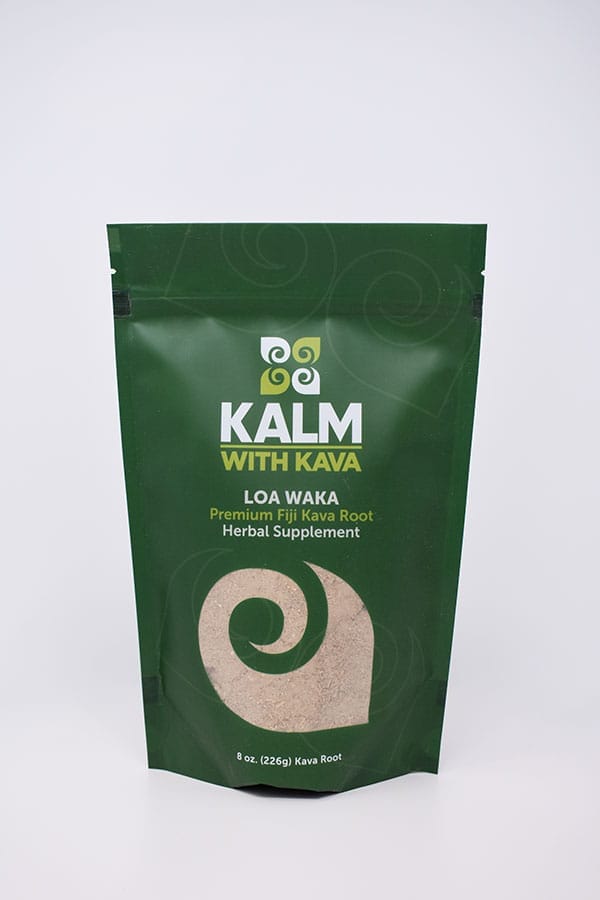
Kalm with Kava — Fiji Loa Waka (Medium Grind)
Kalm with Kava
Traditional brew base for lattes and coladas — real root weight that carries coconut, spice, and cream.
Our verdict: The creamy and warm recipes need something a can can't give them: body. A properly kneaded traditional brew has real weight and full strength, which is exactly what stands up to coconut milk, turmeric, and honey without vanishing. Loa Waka is lab-tested, 100% noble, single-origin Fiji root — the clean, strong base the colada, the golden latte, and the Traditional-Plus are built on.
Lab report: Lab-tested, 100% noble kava; single-origin Fiji (Loa Waka cultivar).
For the recipes where texture is the point, you brew. A flavored can is light by design; a coconut-forward Kava Colada or a spiced Golden Kava Latte wants a base with body and full kavalactone strength to carry all that richness. Fiji Loa Waka from Kalm with Kava is that base: a single-origin Fijian cultivar, lab-tested and 100% noble, kneaded into a strong, clean brew using the standard 1:10 ratio in warm (never boiling) water. Made well, it tastes earthy and bright — and in these recipes, the coconut and spice round its edges into something genuinely delicious.
The honest caveats: this is the most effort of the four bases — there's a strainer bag, a 10-minute knead, and a cleanup. And it tastes fully like kava on its own, which is the whole reason these recipes exist. But for the colada, the latte, and the purist's Traditional-Plus, nothing else delivers the strength and body the drink needs. Cold-serve everything; chilled kava is dramatically more drinkable than warm.
Who should buy it
Buy Loa Waka as your base when the recipe needs body and real strength — the creamy coladas, the warm spiced lattes, the proper Traditional-Plus session. It's also the right learning bag: lab-tested noble root so that when a batch comes out strong, you know it was the kava, not luck.
What we don't like
It's the highest-effort base here — a strainer bag, a timed knead, and cleanup stand between you and the drink — and you pay a transparency premium of roughly 30–40% over bulk root for the lab testing and single-origin sourcing. Wrong pick if you wanted a 90-second recipe.
- Form
- Traditional (medium) grind kava root
- Cultivar
- Loa Waka — 100% noble, single-origin Fiji
- Best recipe role
- Creamy and warm builds where body matters
- Size
- 8 oz (~225 g) — roughly 7–8 base batches
- Testing
- Lab-tested for noble variety and quality
What we like
- Real body and full strength — carries coconut, spice, and cream
- Lab-tested, single-origin noble root
- Cheapest per serving once you're brewing your own base
- The clean reference flavor for what good kava tastes like
Worth noting
- Highest effort of the four bases — knead, strain, clean up
- Transparency premium over bulk bags
- Tastes fully like kava on its own — needs the recipe

MELO Sparkling Kava (Mixed Pack)
MELO
Sparkling base with a disclosed dose — the built-in carbonation does the mule and refresher's work for you.
Our verdict: Some recipes want the fizz baked in. MELO is a sparkling, flavored kava with a disclosed dose per can, which makes it the cleanest base for anything that would otherwise need soda water or ginger beer — the mule and the berry refresher build straight off the bubbles. You open, you add the sharp stuff (lime, ginger, fruit), and the carbonation is already handled.
Lab report: Lab-tested; kavalactone dose disclosed per can.
When a recipe's whole personality is the sparkle, start sparkling. MELO Sparkling Kava from MELO is a flavored, carbonated kava with the dose disclosed on the can — and that built-in fizz is doing real recipe work. For the Kava Moscow Mule and the Berry Kava Refresher, it means you skip the soda-water step entirely and pour your kava base over the aromatics: lime and ginger for the mule, muddled berries for the refresher.
Where it's not the answer: like any can, it's gentler than a hand-kneaded traditional batch and pricier per milligram of kavalactones, so it's a mixer-and-spritz base, not a creamy-colada base. Match it to the fizzy recipes and it shines; ask it to carry a coconut-heavy build and you'll wish you'd started from root.
Who should buy it
Pick MELO as your base for the carbonated recipes — the mule, the refresher, any build where you'd otherwise crack a separate soda water. It's also a strong choice for someone who wants a disclosed dose and a finished drink without owning a single piece of kava gear.
What we don't like
Same trade as any RTD can: it's milder and costs more per milligram than root, so it's wrong for the body-forward recipes. Flavor availability varies by pack, so the exact fruit note you build around may shift between restocks.
- Form
- Sparkling, flavored ready-to-drink kava
- Best recipe role
- Carbonated builds — mules, refreshers, spritzes
- Dose
- Disclosed per can
- Contains
- No alcohol
- Testing
- Lab-tested; dose disclosed
What we like
- Built-in carbonation — no separate soda water needed
- Disclosed dose for repeatable, paceable drinks
- Flavored and easy-drinking straight from the can
- No alcohol
Worth noting
- Gentler than traditional root — not a creamy-build base
- Costs more per milligram of kavalactones than powder

Root of Happiness Instant Kava (50g)
Root of Happiness
No-strain instant for quick mixing — dissolves into any liquid, so you get root-level strength without a bag.
Our verdict: Sometimes you want a brew's strength without a brew's effort. Instant kava is dehydrated, water-soluble kava that stirs straight into liquid — no strainer bag, no 10-minute knead — which makes it the ideal shortcut base for recipes that need real kava weight fast, like the espresso-martini mocktail and a quick colada. You dose it by the scoop, it disappears into the drink, and you're done.
Lab report: Instant (dehydrated kava); kavalactone content stated on the label.
Instant is the bridge between the can and the bowl. Root of Happiness Instant Kava from Root of Happiness is real kava that's been brewed and dehydrated into a soluble powder, so it dissolves into water, milk, or cold brew without a bag or a knead. For the Kava Espresso Martini mocktail it's perfect — you want kava strength stirred into cold brew, not a fizzy can, and you don't want grit. A scoop in, a brisk stir, and you have a dosed kava base in under a minute.
The trade-offs, stated plainly: instant generally costs more per gram of kavalactones than bulk root, and the flavor — while less silty — is still recognizably kava, so you're still building a recipe around it, not drinking it neat for pleasure. But for speed-with-strength and a clean dissolve, it's the most versatile mixing base of the four.
Who should buy it
Reach for instant when you want a brew's strength without the strainer bag — the espresso-martini mocktail, a fast colada, any recipe where you need kava to dissolve clean into another liquid. It's also the travel-friendly base: a jar of instant makes a kava drink anywhere there's a glass.
What we don't like
It costs more per gram of kavalactones than bulk traditional root, and it still tastes like kava — instant dials the silt down, not the earthiness, so it's a base to build on, not a sip-it-straight pleasure. Strength per scoop varies by brand, so read the label before you free-pour.
- Form
- Instant (dehydrated, water-soluble) kava
- Best recipe role
- Fast, clean-dissolving builds — espresso martini, quick colada
- Prep
- Stir into any liquid — no bag, no knead
- Texture
- Dissolves clean — no sediment
- Testing
- Kavalactone content stated on the label
What we like
- No strainer bag, no knead — dissolves in seconds
- Clean dissolve, no silt — ideal for smooth, blended drinks
- Root-level strength in a scoop
- Travel-friendly — a kava drink anywhere
Worth noting
- Costs more per gram of kavalactones than bulk root
- Still tastes like kava — a base, not a neat sipper
- Strength per scoop varies by brand — read the label
The Kava Colada, step by step
- 1
Make a concentrated kava base
Knead 30–35 g of Loa Waka medium-grind root into 250 ml of warm (100–110°F) water for 10 timed minutes in a strainer bag, then chill — or, for the fast route, dissolve 1 scoop of instant kava in 4 oz (120 ml) of cold water. You want a strong, concentrated base because it's about to be mixed with juice and coconut. Never use boiling water: heat degrades the kavalactones and turns the root's starch to sludge.
- 2
Measure 4 oz of cold kava base
Pour 4 oz (120 ml) of your cold concentrated kava base into a blender. Cold is non-negotiable here — chilled kava is dramatically more drinkable, and a frozen colada needs everything starting cold so the ice doesn't melt out before it blends.
- 3
Add pineapple juice — your built-in chaser
Add 3 oz (90 ml) of pineapple juice. This is doing double duty: it's the tropical flavor of the drink AND it's the classic kava chaser built right into the recipe, the same pineapple that kava bars hand you to reset your palate. Its sharp sweetness is what erases the earthiness most effectively.
- 4
Add coconut milk for body and the edge-rounding
Add 2 oz (60 ml) of coconut milk or cream of coconut. The coconut fat is the island-classic fix for kava's hard edges — a little fat genuinely rounds the flavor — and it's what gives the colada its creamy body. Use cream of coconut for a sweeter, dessert-leaning drink or plain coconut milk for a lighter one.
- 5
Add ice and blend until frosty
Add about 1 cup of ice and blend on high for 20–30 seconds until smooth, thick, and frosty. Don't over-blend, which thins the texture as the ice melts. You're aiming for a pourable-but-thick frozen drink — like a colada, because that's what this is.
- 6
Pour, garnish, and drink it briskly
Pour into a tall glass, garnish with a pineapple wedge and a cherry, and drink it while it's cold and frosty. Drink briskly rather than nursing it — kava is best fresh and cold, and the pineapple does its chaser work best in the moment. Mind your dose, keep it to the evening, don't add alcohol, and don't drive afterward.
More kava worth comparing
Beyond this guide: the highest-rated kava across every format, kavalactones verified, with a live price check on each.



As an Amazon Associate we may earn from qualifying purchases, at no cost to you. 21+.
Quick shop: every pick
Skip the scroll: the whole lineup, with a live price check on each.
- Leilo Kava TonicThe Effortless Spritz BaseLeilo · $49.99 / 12-packCheck Price
- Kalm with Kava — Fiji Loa Waka (Medium Grind)The Body-Forward Brew BaseKalm with Kava · ~$39.99 / 8ozCheck Price
- MELO Sparkling Kava (Mixed Pack)The Sparkling Mixer BaseMELO · Check site / mixed packCheck Price
- Root of Happiness Instant Kava (50g)The No-Strain Speed BaseRoot of Happiness · Check site / 50gCheck Price
Key terms
- Chase
- The fruit juice (classically pineapple) or bite of fruit you take immediately after a shell of kava to reset your palate — the single most effective taste fix and standard practice at every kava bar. In recipes, the smartest move is to build the chaser in: the pineapple juice in the Kava Colada is both flavor and chaser at once.
- Instant kava
- Real kava that's been brewed and dehydrated into a water-soluble powder, so it stirs straight into any liquid with no strainer bag and no knead — and dissolves clean, with none of the silt micronized kava leaves behind. That clean dissolve makes it the ideal base for smooth, blended cocktails like the espresso-martini mocktail.
- Traditional grind
- Medium-ground kava root meant to be kneaded in a strainer bag and strained out, leaving a strong, smooth brew. It delivers the most body and full strength of any prep, which is why it's the base for the body-forward recipes — the colada, the golden latte, and the Traditional-Plus — where a flavored can would be too light.
- Makas
- The spent root pulp left in the strainer bag after kneading — the 'grounds' of traditional kava. The makas carry the gritty, intensely earthy solids you specifically don't want in a cocktail, which is the whole reason recipes use either strained traditional brew or clean-dissolving instant: both leave the makas out of your glass.
Questions, answered
Can I mix kava with alcohol?
No — this is the one mixing rule on this page with no exceptions. Every recipe here is deliberately zero-proof, and that's a feature, not a limitation: kava is fundamentally an alcohol-free evening drink, and combining the two is a genuinely bad idea rather than a fun cocktail variation. We cover the full reasoning in our dedicated guide on kava and alcohol (/journal/kava-and-alcohol). If you want a 'cocktail,' the whole point of these recipes is that kava can carry one entirely sober — the colada, the espresso-martini mocktail, the mule — so you get the ritual and the real-drink experience with nothing to mix it with that you shouldn't. When you want a drink in your hand at 9 p.m. that isn't wine, this is the answer; don't undo it by adding the wine.
What's the best kava for cocktails?
It depends entirely on the recipe, which is why we use four bases. For light, fizzy builds — the spritz, the mule, the berry refresher — start from a flavored or sparkling can (Leilo or MELO), because they're already drinkable and the carbonation or flavor is doing recipe work for you. For creamy, body-forward drinks where the kava has to stand up to coconut and spice — the colada and the golden latte — brew a strong traditional batch (Loa Waka medium grind) so there's real weight behind the richness. And for anything that needs a brew's strength with a can's convenience — the espresso-martini mocktail, a quick colada — reach for a no-strain instant (Root of Happiness), which dissolves clean with no silt. Match the base to the build and every recipe gets easier; mismatch it and you'll either drown a light can or wrestle a heavy brew.
Does heat ruin kava?
High heat does, yes — and it's the most common way a kava recipe goes wrong. Kavalactones are heat-sensitive, and the kava community's settled consensus is that you want warm water in the 100–110°F range for extraction; pushing well past that starts degrading the very compounds you're after, and boiling water also gelatinizes the root's starch into a strainer-clogging sludge. That's why none of these recipes boil kava, and why the one warm drink here — the Golden Kava Latte — is built by heating the coconut milk and spices first and then stirring the kava in off the heat, so the kava is only ever gently warmed, never cooked. The simple rule: if it's too hot to comfortably hold your finger in, it's too hot for the kava. Cold-serve everything else, both because cold protects the kava and because chilled kava simply tastes far better.
Can I batch these for a party?
Some of them, with a caveat. The brew-based drinks scale well in advance: make a large concentrated kava base, chill it, and you can build coladas, golden lattes, and Traditional-Plus shells from it all evening — a single 8 oz bag of root yields enough base for a small gathering. What you should NOT batch hours ahead is anything with fresh muddled fruit or carbonation: the berry refresher and the spritz go flat and dull if they sit, so prep the components (juice the limes, muddle the berries) and assemble per-glass. Brewed kava itself keeps refrigerated for about 24–48 hours and will separate as the root settles — that's normal, just stir before pouring. Two house rules for a party: keep these zero-proof (no alcohol, ever), and make sure guests know the dose, since a tasty kava cocktail removes the earthy flavor that would otherwise pace them — our dosage guide (/journal/kava-dosage-guide) covers sensible pacing.
How strong are these kava drinks?
It varies by base, which is exactly why you should track it rather than guess. The canned bases (Leilo, MELO) disclose a kavalactone dose per can — Leilo lists about 125 mg — so a single-can recipe is a known quantity and lands on the gentler side. The brew and instant bases are stronger and depend on how you make them: a concentrated traditional batch built for a colada packs real strength. The catch with any tasty kava cocktail is that the earthy flavor which normally slows you down is gone, so it's easy to drink faster than you would a plain brew. Treat that as the one thing to watch: pace by the clock and the label, not by taste. Kava also has a well-known reverse tolerance — first sessions often feel mild — so don't chase a bigger effect by over-pouring on night one. Our dosage guide (/journal/kava-dosage-guide) lays out how sessions are actually paced. These are 21-and-up evening drinks; don't drive after, and this isn't medical advice.
What hides the kava taste best?
In rough order of effectiveness: a flavored can hides it most completely (Leilo and MELO are engineered so there's barely any earthiness left to hide), then coconut-and-fruit blends like the colada (coconut fat rounds the edges, pineapple's sharp sweetness erases the aftertaste — both with real island pedigree), then the cold-brew espresso-martini (coffee's roasted bitterness and kava's earthiness read as 'dark and complex' together rather than muddy), then bright citrus-and-berry builds. The one thing that does NOT work is the rookie instinct to drown kava in a giant smoothie — you don't get tasty kava, you get a large glass of bad-tasting drink you now have to finish, and the kava is no weaker for it. The honest gold standard from our taste guide (/journal/what-does-kava-taste-like) isn't hiding the flavor at all — it's the chase: drink your shell briskly, then immediately follow with pineapple juice. Three seconds, palate reset, full strength preserved. The colada simply builds that chase right into the blender.
Keep reading
What Does Kava Taste Like?
The honest descriptors, why it tastes that way, and the ranked taste-fix hierarchy these recipes are built on.
How to Make Kava
The ratios, the warm-not-boiling water, and the 10-minute knead — how to build the concentrated base these recipes call for.
Best Kava Drinks
The ready-to-drink cans and tonics that double as recipe bases — ranked and graded honestly.