Our Pick: Bula Kava House
Check PriceBula Kava House vs Kalm with Kava (2026): Which Traditional Vendor Wins?
Two of the most respected names in traditional noble kava, both selling single-origin root by named cultivar, both trusted by the people who actually own a strainer bag. We put them head to head on the check that separates good vendors from great ones — does the brand publish the lab paperwork? — and the verdict turns on a single, decisive difference.
By The Kava Review DeskUpdated 2026-06-17~8 min read Ranked by the lab reportHow we research
 Best Overall
Bula Kava House Borogu Kava Powder
Bula Kava House · 4.6
From $17.60 (100g sample · 1/2 LB · 1 LB)
Ask the home-kava crowd to name two vendors they'd order traditional grind from sight unseen, and Bula Kava House and Kalm with Kava both make the short list. They are kindred operations: independent, long-running noble-kava houses that sell single-origin root by named cultivar — Borogu from Vanuatu, Waka from Fiji — the way a serious coffee shop sells beans by farm rather than a generic house roast. Neither is a white-label dropshipper, both carry traditional grind alongside easier micronized formats, and both have spent more than a decade earning community trust. On paper, picking between them looks like splitting hairs.
It isn't, and the reason is the one thing our desk checks before anything else: the paper trail. A kava vendor can name its cultivars, certify its root noble, and promise it lab-tests every batch — and both of these brands do exactly that. But promising testing and publishing the certificate of analysis are two different things, and in kava that gap is the whole ballgame. When we went looking for the actual documents, the two brands landed on opposite rungs of the same ladder. That single divergence does most of the work in this comparison, and it's why a matchup that should be a coin flip has a clear winner on the axis we weight hardest.
Everything below was verified against each brand's own pages, testing policies, and live product listings in June 2026 — the cultivars, the formats, the starting prices, and the exact wording each brand uses about its lab testing. To be clear up front: this is independent and unpaid. Neither Bula Kava House nor Kalm with Kava sponsored this, paid for it, or reviewed it before publication. We bought the question the way you would — which heritage vendor deserves your first order — and answered it honestly, including where the honest answer is "it depends on what you value." Usual ground rules: kava is for adults, it can cause drowsiness, don't drive after drinking it, and if you take medications or are pregnant, talk to your doctor first. None of this is medical advice.
The short version
- Transparency is the whole fight, and Bula Kava House wins it outright: it publishes a per-varietal certificate of analysis, linked from the product pages, naming origin, chemotype, and total kavalactone percentage. Kalm with Kava says it third-party lab tests every batch but publishes no downloadable COA or kavalactone figure we could find.
- Both are legitimate, established noble-kava houses — Bula a Portland kava bar and shop running since 2011, Kalm with Kava a noble-kava house founded in 2010 — and both sell single-origin root by named cultivar, which already puts them above the anonymous-bulk field.
- Selection is close, with different flagships: Bula's pillars are Borogu (Vanuatu) and Fijian "White Waka" made from 100% lateral roots; Kalm with Kava's flagship is Loa Waka (Fiji, 100% lateral roots), with Borogu also in the lineup.
- Value goes to Bula on starting price: Borogu traditional grind starts at $17.60 and Waka at $19.80, while Kalm with Kava's Loa Waka Traditional Grind runs about $38.99 for 8 oz — premium-vendor pricing rather than bulk.
- Both cover the same prep range — traditional grind for veterans, micronized for beginners — so a first-timer and a strainer-bag regular can shop either source. Bula's instant line starts at $29.70 (single-cultivar micronized ~$56–$59); Kalm's micronized runs ~$36.49–$66.99 by size.
- Honest caveat on Kalm with Kava: its reputation and noble-only sourcing are strong, and the missing COA is a documentation gap, not evidence of a quality problem — but on our standard, an unposted lab sheet is the difference between proof and a promise.
- Verdict: Bula Kava House takes it for buyers who rank published lab numbers and fair entry pricing first; Kalm with Kava is still an excellent pick for traditionalists who prize its specific Loa Waka cultivar and 15-year community standing.
At a glance
| Bula Kava House | Kalm with Kava | |
|---|---|---|
| Published COAs | Yes — per-varietal certificate of analysis, linked from the product pages | No downloadable per-batch COA we could find — testing is asserted, not posted |
| Kavalactone / chemotype disclosure | COA names chemotype and total kavalactone percentage per varietal | Markets "lab tested for strength" but states no kavalactone percentage we could find |
| Heritage | Portland kava bar (nakamal) + online shop since 2011; founder Judd Rench; American Kava Association member | Noble-kava house founded 2010 by Mike Munsell; now run by Tiffani Munsell |
| Flagship cultivars | Borogu (Vanuatu) and "White Waka" (Fiji, 100% lateral roots) | Loa Waka (Fiji, 100% lateral roots); Borogu (Vanuatu) also offered |
| Traditional-grind starting price | Borogu from $17.60; Waka from $19.80 | Loa Waka Traditional Grind ~$38.99 / 8 oz |
| Beginner format | Instant/micronized line from $29.70 (single-cultivar micronized ~$56–$59) | Loa Waka Micronized ~$36.49–$66.99 by size (4.67/5 customer rating) |
Bula Kava House vs Kalm with Kava at a glance — cultivars, formats, prices, and disclosures verified June 2026. The transparency row is the one our desk weights hardest.
Bula Kava House Borogu Kava Powder
Bula Kava House
Vanuatu's everyday noble root at a fair entry price — and the only side of this matchup that ships with a published COA you can read.
Our verdict: Borogu is the cleanest expression of why Bula wins this matchup: it pairs a genuinely fair starting price with the disclosure standard the other side doesn't meet. It's Vanuatu's classic everyday noble cultivar, traditional grind, peppery and reliably potent — and it ships with a COA naming origin, chemotype, and kavalactone percentage, linked from the product page. A 100g sample lets you trial it before committing. Real homework to prepare, but real kava with the receipts.
Lab report: Published per-varietal COA disclosing Vanuatu origin, chemotype, and total kavalactone percentage; certified noble; screened for yeast, mold, and microbial contamination — every batch, per the testing policy.
This is the product that settles the comparison. Bula's Borogu Kava Powder is traditional-grind noble root from Vanuatu — the country's most widely consumed and most exported kava — milled for the strainer bag. You knead it into water, strain out the fibrous makas, and drink the cloudy result, peppery and potent, the everyday heady-then-heavy profile Vanuatu drinkers reach for in the afternoon and evening. On its own merits it's a default daily driver. In this matchup, it's also the side that shows its work.
It's the better value on entry, too. Borogu starts at $17.60 with a 100g sample to trial it, where Kalm with Kava's comparable Loa Waka Traditional Grind runs about $38.99 for 8 oz. The experience is genuinely traditional, which is both the appeal and the cost: expect the earthy, peppery flavor real root delivers, the tongue-numbing tingle within a minute, and a body-forward calm that builds over the session. Newcomers should know about kava's reverse tolerance — the first session or two often feel mild, with the effect arriving more clearly on later tries — and you'll need a strainer bag and a few minutes of kneading. Not a stir-and-sip product. The one you graduate to when you want the real thing, documented.
Who should buy it
Buy Bula's Borogu if you want a heritage vendor that actually posts its lab paperwork, a fair starting price, and authentic Vanuatu traditional grind you're willing to strain yourself. The 100g sample makes it a low-risk first try, and the published COA makes it the pick for anyone who ranks verifiable transparency above brand reputation alone.
What we don't like
It's traditional grind, which means homework: a strainer bag, kneading, straining, and an earthy flavor the seltzer crowd will find punishing. And like nearly all powder vendors — Kalm with Kava included — the COA gives you a kavalactone percentage, not a guaranteed milligram-per-serving figure, because that depends on how you brew it. The disclosure is the percentage, not your exact cup.
- Origin
- Vanuatu — noble cultivar (Borogu)
- Type
- Traditional grind — requires straining to brew
- Testing
- Published per-varietal COA: chemotype, total kavalactone %, contaminant screen; certified noble
- Pack sizes
- 100g sample · 1/2 LB · 1 LB
- Starting price
- From $17.60
What we like
- Published per-varietal COA names origin, chemotype, and kavalactone % — the decisive edge here
- Fair starting price ($17.60) with a 100g sample to trial it
- Vanuatu's classic everyday noble variety — reliable, potent, peppery
- Certified noble, not tudei; backed by every-batch testing
Worth noting
- Traditional grind: strainer bag, kneading, and earthy taste required
- No guaranteed per-serving kavalactone milligram figure (brew-dependent, as with all powders)
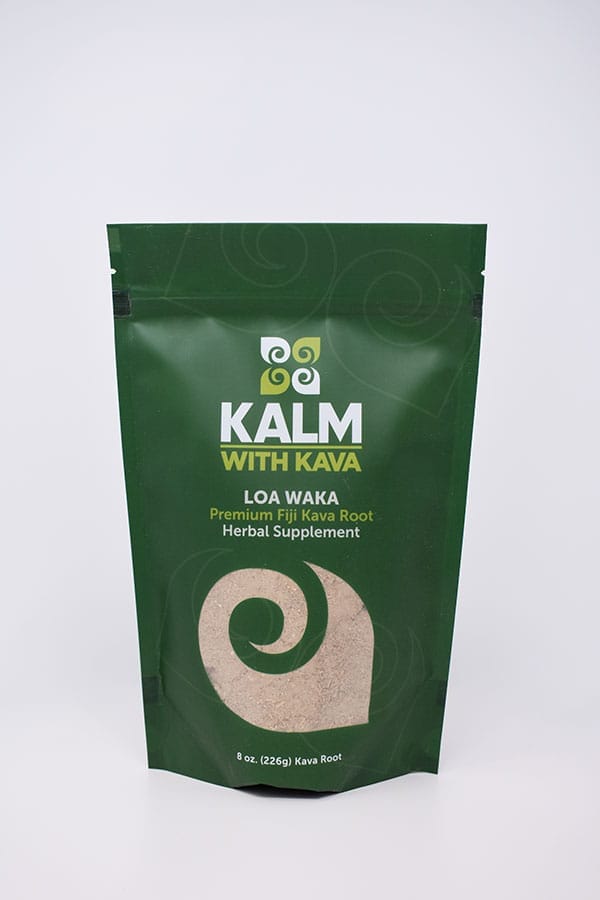
Kalm with Kava Loa Waka Traditional Grind
Kalm with Kava
A single-origin Fijian waka the community has trusted for years — held back only by lab numbers it claims but doesn't publish.
Our verdict: Loa Waka Traditional Grind is the product that explains why traditionalists default to Kalm with Kava: a named single-origin Fijian cultivar from 100% lateral roots, ground for the strainer bag, marketed as the strongest and most balanced root the house carries, from a 15-year vendor the community trusts. At roughly $38.99 for 8 oz it isn't bulk-cheap. And the one thing keeping it from beating Bula here is the document — "lab tested" is claimed, not posted.
Lab report: Marketed as 100% noble, made from 100% lateral roots (waka), and described as third-party lab tested for safety, strength, and nobility — but we found no downloadable per-batch COA or stated kavalactone percentage on the product page.
This is the product that earns Kalm with Kava its reputation. Loa Waka Traditional Grind is a single-origin Fijian kava sold by cultivar name — not a blend, not a mystery "premium" label — and it's made from 100% lateral roots, the waka grade traditionalists prize for potency. The traditional (medium) grind is the format you knead in a strainer bag the old way, and the brand markets Loa Waka as the strongest and most balanced cultivar it carries: heady up front, heavier as the session goes. For someone who already drinks kava and wants to choose their root the way a coffee drinker chooses a single-origin bean, Kalm with Kava is one of the few US vendors that makes that possible — which is exactly why it's a real contender against Bula.
As a drinking experience, traditional grind is the connoisseur's format and the beginner's hurdle either way: you need a strainer bag, a few minutes of kneading, and a tolerance for kava's earthy, peppery slurry. The payoff is the fullest expression of the root and the lowest cost-per-serving within the brand's own lineup. Loa Waka's balanced profile — the tongue-numbing tingle arrives quickly, the relaxation settles over the first half hour — is what most people want in an everyday kava, and reverse tolerance applies as always: your second and third sessions tend to speak louder than your first. One logistics note worth weighing if you're outside the US: public reviews flag international parcels stuck in customs, though domestic shipping is generally unremarkable.
Who should buy it
Buy Kalm with Kava's Loa Waka if you specifically want this trusted Fijian cultivar, you value a 15-year community reputation, and the missing public COA isn't a dealbreaker for you. It's the right pick for the kava drinker who's standardized on Loa Waka or wants a single balanced everyday cultivar from a heritage house — and you can always ask the brand for the COA on your batch before ordering.
What we don't like
The transparency gap is the real knock and the reason it loses to Bula here: the brand says "lab tested for safety, strength, and nobility," but we couldn't find a downloadable COA or a stated kavalactone percentage, so the strength claim is a promise rather than a published figure. The price is firmly premium versus Bula's $17.60–$19.80 entry powders, and traditional grind requires straining — beginners should start with the micronized version instead.
- Cultivar
- Loa Waka (single-origin Fijian noble kava)
- Root grade
- 100% lateral roots (waka) — the stronger cut
- Format
- Traditional / medium grind (requires a strainer bag)
- Testing
- Marketed as 100% noble, "third-party lab tested" — no public per-batch COA found
- Price
- ~$38.99 / 8 oz (also sold via Amazon and Walmart)
What we like
- Named single-origin Fijian cultivar from 100% lateral roots — not a generic blend
- Trusted 15-year vendor with a strong community reputation
- Marketed as the strongest, most balanced cultivar the house carries
- Also available micronized for beginners (4.67/5 customer rating)
Worth noting
- No downloadable per-batch COA or stated kavalactone % we could find — the decisive gap
- Premium pricing versus Bula's lower-entry traditional powders
- Strainer-bag prep is a barrier for first-timers; international shipping can hit customs delays
More kava worth comparing
Beyond this guide: the highest-rated kava across every format, kavalactones verified, with a live price check on each.


As an Amazon Associate we may earn from qualifying purchases, at no cost to you. 21+.
Quick shop: every pick
Skip the scroll: the whole lineup, with a live price check on each.
- Bula Kava House Borogu Kava PowderThe Transparent OneBula Kava House · From $17.60 (100g sample · 1/2 LB · 1 LB)Check Price
- Kalm with Kava Loa Waka Traditional GrindThe Traditionalist's FavoriteKalm with Kava · ~$38.99 / 8 ozCheck Price
How we chose
We judge two kava vendors the same way we judge one: by the paper trail first. For each brand we read the public testing policy and went looking for the actual certificate of analysis — not the marketing claim, the document. We checked three things on each side: does the brand publish COAs at all; are those COAs linked from the product pages rather than buried or absent; and do they disclose the figures that matter — country of origin, chemotype, and total kavalactone percentage. Where a brand posts the document, we credit it; where the number is asserted but not published, we flag it as a gap rather than estimating a figure the brand never stated.
Then we line up the catalogs on equal terms. We confirmed each brand's flagship cultivars, formats, and starting prices against the live listings in June 2026 — Bula's Borogu, Waka, and instant line; Kalm with Kava's Loa Waka traditional grind and micronized. We compare like with like (traditional grind to traditional grind, micronized to micronized) and we name what we couldn't independently confirm instead of rounding up. We do not invent kavalactone numbers, fabricate tasting panels, or convert an unstated figure into a fake one.
Finally we weigh them as buying experiences and as drinks, in plain experiential terms — and we keep the cautions on the label. Traditional grind is preparation-heavy and earthy whichever vendor you buy it from; micronized is easier but pricier per pound. What we never do is make health claims. Kava is a centuries-old Pacific social drink that many adults find relaxing; it is not a treatment for anything, it can cause drowsiness, and anyone on medications should check with a doctor first. This comparison is independent and not sponsored by either brand.
Key terms
- COA (Certificate of Analysis)
- A lab document reporting what's actually in a batch — for kava, the chemotype, total kavalactone percentage, and contaminant screen. The trust ladder runs: published per varietal and linked from the product page (best, which Bula does), available on request (acceptable), "we lab test" with nothing posted (a claim, not evidence — where Kalm with Kava currently reads). It's the single check that decides this comparison.
- Noble kava
- The traditional cultivars Pacific growers raise for everyday drinking, prized for a smooth, agreeable effect with minimal next-day heaviness. Both Bula Kava House and Kalm with Kava certify their kava noble — the opposite of harsher tudei kava — so on sourcing intent the two brands agree; they diverge on whether they post the proof.
- Cultivar
- A named kava variety from a specific origin — Borogu (Vanuatu), Loa Waka (Fiji) — with its own effect profile. Buying by cultivar is to kava what single-origin is to coffee, and both brands here sell that way, which is exactly why they're worth comparing against the anonymous-bulk field.
- Lateral roots (waka)
- The thin side roots of the kava plant, traditionally prized for a cleaner, more euphoric, head-forward effect. Both flagships in this matchup lean on it — Bula's Fijian "White Waka" and Kalm with Kava's Loa Waka are both made from 100% lateral roots — a sourcing spec that's easy to claim and harder to document.
- Traditional grind vs. micronized
- Traditional (medium) grind is kneaded in a strainer bag and strained out — the classic, lowest-cost-per-serving prep, the format both brands' flagships use. Micronized is milled fine enough to drink whole, no straining, stronger per gram but grittier; both vendors also offer it as the beginner on-ramp.
- Reverse tolerance
- Kava's well-known quirk: first sessions often feel mild, with the effect arriving more clearly on the second or third try. Worth knowing before you judge either vendor's root on a single pour — and a reason not to double up on night one.
Questions, answered
Bula Kava House or Kalm with Kava — which is better?
It depends on what you value, but on our standard the edge goes to Bula Kava House. Both are legitimate heritage noble-kava houses that sell single-origin root by named cultivar, but Bula publishes a per-varietal certificate of analysis (naming origin, chemotype, and total kavalactone percentage) linked from its product pages, and it starts cheaper — Borogu from $17.60, Waka from $19.80. Kalm with Kava says it third-party lab tests every batch but, as of our June 2026 check, doesn't post a downloadable COA or a stated kavalactone figure we could find, and its comparable Loa Waka Traditional Grind runs about $38.99 for 8 oz. Want proof and a fair entry price → Bula. Want the specific Loa Waka cultivar from a 15-year-trusted house → Kalm with Kava.
Does Bula Kava House or Kalm with Kava publish lab tests and COAs?
This is the central difference. Bula Kava House publishes a COA for each varietal, linked from both its testing-policy page and the individual product pages, disclosing country of origin, processing date, chemotype, total kavalactone percentage, and contaminant results, with testing on every batch. Kalm with Kava markets its kava as 100% noble and third-party lab tested for safety, strength, and nobility — the right posture — but we could not find a downloadable per-batch COA or a stated kavalactone percentage on its product pages. So Bula offers a document you can read; Kalm with Kava offers a claim you're asked to trust. That's why Bula takes our pick.
Which vendor is cheaper for traditional grind?
Bula Kava House, on starting price. Its Borogu traditional grind starts at $17.60 and its Fijian Waka at $19.80, both with a published COA, and the Borogu offers a 100g sample for a low-risk first try. Kalm with Kava's comparable Loa Waka Traditional Grind runs about $38.99 for 8 oz — premium-vendor pricing rather than bulk. You're paying the Kalm premium for a specific named cultivar and a long community track record, which is defensible; but if entry cost matters, Bula is the cheaper way into documented traditional grind.
Which is better for a beginner — Bula or Kalm with Kava?
Both cover beginners with a micronized (no-strain) format, so either works. Kalm with Kava's Loa Waka Micronized (~$36.49–$66.99 by size) carries a strong 4.67/5 customer rating and is its recommended on-ramp. Bula's Instant Kava Root Drink Mix starts at $29.70 (single-cultivar micronized varietals run ~$56–$59) and is backed by the same COA-supported supply as its powders. For a first-timer who also wants to see the lab paperwork, Bula's documented supply gives it the edge; for someone set on the Loa Waka cultivar, Kalm with Kava's micronized is the move. Either way, micronized means you drink the whole root — easier prep, grittier texture.
Are both brands' kava noble, and do they sell by cultivar?
Yes on both counts, which is why they're worth comparing. Bula Kava House certifies all of its kava noble (not tudei) and sells named single-origin cultivars — Borogu from Vanuatu, "White Waka" from Fiji made from 100% lateral roots, plus Tongan and other varietals. Kalm with Kava commits to 100% noble kava only and sells by named cultivar too — its flagship Loa Waka is Fijian from 100% lateral roots, with Borogu from Vanuatu also offered. Both reject the anonymous-bulk model. The difference, again, is that Bula posts the COA that backs the noble claim, while Kalm with Kava asserts it without publishing the document.
Is Kalm with Kava still worth buying if it doesn't publish COAs?
For many drinkers, yes. The missing public COA is a documentation gap, not evidence of a quality problem — Kalm with Kava has a strong community reputation, a 15-year track record, and a 100% noble, named-cultivar commitment, all of which point toward a quality product. If you specifically want its Loa Waka cultivar or value its heritage, it remains an excellent vendor, and you can ask the company for the COA on your batch before ordering. We simply hold the standard that a posted lab sheet beats an unposted one — so when a comparable competitor (Bula) publishes the document and charges less to start, that competitor earns our pick.
What about shipping and reliability?
Bula Kava House has run a Portland kava bar and national online shop since 2011 and is a member of the American Kava Association. Kalm with Kava, founded in 2010, ships through its own site as well as Amazon and Walmart; domestic US shipping is generally unremarkable, but public reviews flag a recurring international issue — parcels stuck in customs for long stretches with limited recourse. If you're ordering within the US, that's unlikely to affect you; if you're ordering internationally, weigh it as a real risk. Neither brand's reliability is in question for domestic buyers.
Is this comparison sponsored or paid?
No. This is not a paid placement, and neither Bula Kava House nor Kalm with Kava sponsored or reviewed it. We may earn an affiliate commission if you buy through our links, but that never changes the verdict — our scoring rewards published transparency, which is exactly why the brand with the readable COA (Bula) took our pick over a brand with a beloved cultivar and a strong reputation (Kalm with Kava). We verified every fact against each brand's own pages and live listings in June 2026 and answered the question honestly, including where the answer is "it depends on what you value."
Keep reading
Bula Kava House Review
Our full, independent verdict on the Portland OG — the testing program, the catalog, and why it clears our transparency bar.
Kalm with Kava Review
The traditionalist's favorite under our standard — named cultivars, community trust, and the one check it doesn't yet pass.
Best Kava Powder
Traditional grind and micronized roots ranked — where both of these heritage vendors sit in the wider field.
Noble vs. Tudei Kava
Why "noble" on a label matters, and how a COA tells you the brand actually checked.
Best Kava Brands
The vendors we trust most across the whole category — and the transparency standard that earns a spot.