Our pick. Kalm with Kava
Check priceKalm with Kava vs Koa Kava (2026): Heritage vs Single-Origin Variety
Two named-cultivar noble houses, head to head. Kalm with Kava is the 15-year traditionalist — single-origin cultivars across traditional grind, micronized, and instant, with the trust of the kava community behind it. Koa Kava is the younger Tongan-rooted specialist — named-origin root from Tonga, Vanuatu, and Fiji, built for tasting by origin. Neither posts a public COA, so we scored them on heritage, range, sourcing, and value. Here's the verdict, split by buyer.
By The Kava Review DeskUpdated 2026-06-27~7 min readRanked by the lab reportHow we research
 Best Value
Koa Kava — Premium Fijian Waka
- Koa Kava
- 4.2
- Price
- From $39.99 (8 oz · 1 lb · $119.99 kilo)
Kalm with Kava and Koa Kava are both vendors a serious kava drinker can shop with confidence: both sell noble root by named cultivar, both come with a real sourcing story, and both — honestly — stop short of posting a certificate of analysis. So the comparison isn't really about who's legitimate. It's about heritage and format range versus single-origin variety, and which of those two things you actually want.
Kalm with Kava is the elder house. Founded in 2010, a fixture on the kava forums, it sells single-origin cultivars by name — Loa Waka from Fiji (made from 100% lateral roots, the stronger waka cut), Borogu from Vanuatu — and crucially offers the same cultivar across traditional grind, micronized, and instant, plus a seltzer. That format range, plus 15 years of community goodwill, is its real edge. Koa Kava is the younger challenger: a Utah-based, Tongan-rooted family shop selling distinct single-origins from three Pacific countries — a Savusavu Fijian Waka named to 100% lateral roots, a heady Tongan, a heavier Vanuatu Waka, a limited-batch Damu, and a three-origin sample pack built for tasting one island against another.
Everything below was checked against our own verified brand reviews of each company. To be clear up front: this is not a paid placement and neither brand sponsored it; we have no relationship with either, and at publication no affiliate relationship with Koa Kava. Both are credible noble vendors; the honest split is between Kalm with Kava's heritage-and-format-range and Koa Kava's single-origin variety — and the fact that neither posts a public COA is a shared limitation we hold both to equally. Usual ground rules: kava is for adults 21+, it can cause drowsiness, don't drive after drinking it, don't mix it with alcohol, and if you take medications or are pregnant, talk to your doctor. None of this is medical advice.
The short version.
- Heritage and format range go to Kalm with Kava: a trusted 15-year noble-only house that offers the same single-origin cultivar (Loa Waka, Borogu) across traditional grind, micronized, and instant — so beginners and strainer-bag veterans can shop one source.
- Single-origin variety goes to Koa Kava: distinct named origins from Tonga, Vanuatu, and Fiji, a Savusavu Fijian Waka spec'd to 100% lateral roots, a limited-batch Damu, and a sample pack built to taste island against island.
- Neither posts a public COA — the shared gap. Kalm with Kava says it's 'third-party lab tested for safety, strength, and nobility' but publishes no per-batch COA or stated kavalactone % we found; Koa Kava states 'every batch 3rd party tested' but publishes no COA, lab name, or percentage. Both are claimed testing, not posted receipts.
- Both are premium-priced and close on the flagship sticker — Kalm's Loa Waka Traditional Grind ~$38.99/8oz, Koa Kava's Fijian Waka from $39.99/8oz — so price isn't the deciding factor.
- Pick Kalm with Kava if you want a beloved heritage vendor and format flexibility (especially a micronized or instant on-ramp). Pick Koa Kava if you want to taste single-origins side by side and value provenance variety; its $59.99 sample pack is the better first buy.
At a glance.
| Kalm with Kava | Koa Kava | |
|---|---|---|
| Positioning | 15-year traditionalist's favorite — named cultivars, format range | Younger Tongan-rooted single-origin specialist |
| Origins | Fiji (Loa Waka), Vanuatu (Borogu), and more | Tonga, Vanuatu, Fiji — sold as distinct single-origins |
| Flagship | Loa Waka — Fiji, noble, 100% lateral roots (waka) | Premium Fijian Waka — Savusavu, noble, 100% lateral roots |
| Flagship price | ~$38.99 / 8 oz (traditional grind) | From $39.99 (8 oz); $119.99 / kilo |
| Format range | Traditional grind, micronized, instant, plus a seltzer | Traditional grind single-origins, instant green line, sample pack |
| Kavalactone % / chemotype | Not published on the product pages | Not published on the public site |
| Testing posture | Marketed 'third-party lab tested'; no per-batch COA posted | Stated 'every batch 3rd party tested'; no COA, lab name, or % posted |
| Best entry | Micronized Loa Waka — no-strain on-ramp from a trusted house | $59.99 three-origin sample pack (4 oz each) + strainer bag |
| Our verdict | The heritage + format-range pick | The single-origin variety pick |
Kalm with Kava vs Koa Kava at a glance — specs drawn from our verified brand reviews. Neither publishes a per-batch COA or kavalactone percentage, so that row reads the same for both.

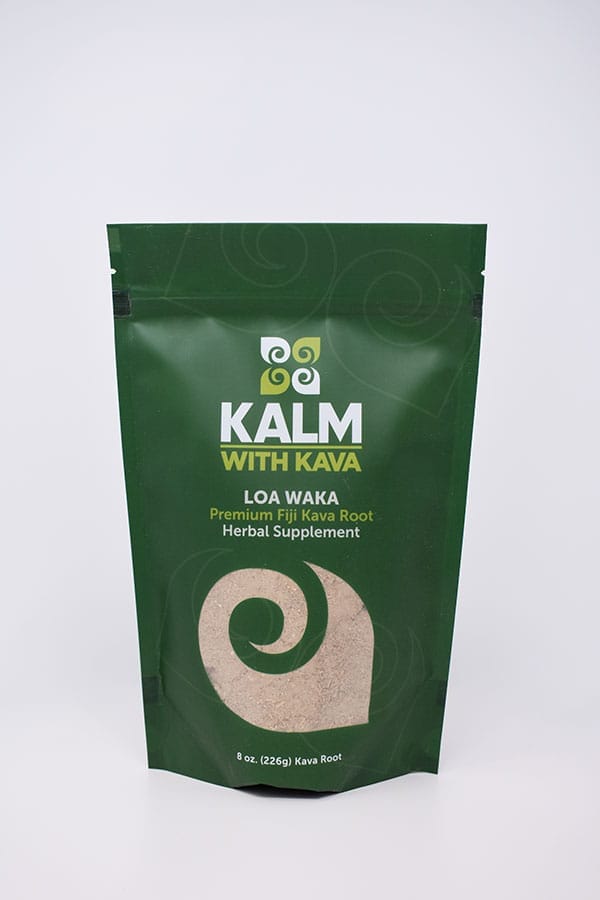
Kalm with Kava — Loa Waka (Medium Grind)
Kalm with Kava
Named single-origin Fijian waka from a 15-year house — the heritage pick, with the format range (micronized, instant) Koa Kava doesn't match.
Our verdict: Loa Waka is the product that explains why traditionalists default to Kalm with Kava: a named single-origin Fijian cultivar made from 100% lateral roots, from a 15-year house the community broadly trusts, available in the grind you knead in a strainer bag — and, crucially, in micronized and instant if you'd rather not. That format flexibility plus heritage is its edge over Koa Kava. At ~$38.99/8oz it's premium, and the one missing thing is the document: 'lab tested' is claimed, not posted.
Lab report. Marketed as 100% noble, made from 100% lateral roots (waka), and described as third-party lab tested for safety, strength, and nobility — but we found no downloadable per-batch COA or stated kavalactone percentage on the product page.
This is the heritage side of the matchup. Kalm with Kava's Loa Waka is a single-origin Fijian kava sold by cultivar name — made from 100% lateral roots, the waka grade prized for potency — in the medium grind you knead the old way. The brand markets it as the strongest, most balanced cultivar it carries: heady up front, heavier as the session goes. Against Koa Kava, whose single-origins are all traditional grind, Kalm's real advantage is range: the same trusted Loa Waka cultivar also comes micronized (no strainer bag) and instant, so a beginner and a veteran can shop one trusted house without changing brands.
As a drinking experience, the medium grind delivers the fullest expression of the root and the lowest cost per serving, with Loa Waka's balanced profile — quick tongue-numbing tingle, relaxation over the first half hour — exactly what most people want in an everyday kava. Reverse tolerance applies. If you're new to home kava, the micronized version is the easiest on-ramp in this whole matchup; if you want named variety to taste side by side, that's where Koa Kava pulls ahead. If a posted COA matters, ask Kalm with Kava for the COA on your batch before buying.
Who should buy it.
Buy Kalm with Kava's Loa Waka if you want a beloved 15-year vendor, a named single-origin Fijian cultivar, and format flexibility — especially a micronized or instant on-ramp from the same trusted source. It's the right pick for the drinker who values heritage and convenience options over tasting many origins.
What we don't like.
Same transparency gap as Koa Kava: 'lab tested' is claimed, but we couldn't find a downloadable COA, chemotype, or stated kavalactone percentage, so the strength claim is a promise, not a published figure. The price is firmly premium, and the catalog leans Fiji/Vanuatu rather than the three-country variety Koa Kava offers — if tasting Tongan against Fijian is the appeal, Kalm with Kava isn't built for that.
- Cultivar
- Loa Waka (single-origin Fijian noble kava)
- Root grade
- 100% lateral roots (waka) — the stronger cut
- Format
- Medium / traditional grind (also micronized + instant)
- Testing
- Marketed 100% noble, "third-party lab tested" — no public per-batch COA or stated % found
- Origin
- Fiji
- Price
- ~$38.99 / 8 oz
What we like.
- Named single-origin Fijian cultivar from a trusted 15-year house
- Made from 100% lateral roots (waka), the stronger grade
- Format range — same cultivar in traditional grind, micronized, and instant
- Deep community track record and reputation for customer service
Worth noting.
- No downloadable per-batch COA, chemotype, or stated kavalactone % we could find
- Premium pricing; catalog leans Fiji/Vanuatu, not three-country variety
- Strainer-bag prep for the traditional grind (micronized solves this)
Koa Kava — Premium Fijian Waka
Koa Kava
Named-origin noble Fijian Waka from a Tongan-rooted shop — built for tasting Tonga vs Vanuatu vs Fiji, premium price, no posted COA.
Our verdict: Koa Kava's Fijian Waka is its most clearly specified product: noble root from Savusavu, Fiji, named to 100% lateral roots — the part prized for a cleaner, more euphoric lift — from a Tongan-rooted family shop selling distinct single-origins. Its edge over Kalm with Kava is variety: Tongan, Vanuatu, and Fijian as separate origins you can taste against each other. The reservation matches Kalm's exactly: 'third-party tested' is stated, but the lab sheet isn't posted.
Lab report. Brand states it is noble and 'rigorously third-party tested to ensure purity and safety,' with every batch tested; however, no COA document, named lab, or kavalactone percentage is published on the public site as of our check.
This is the variety side of the matchup. Koa Kava's Premium Fijian Waka is single-origin noble root from Savusavu, Fiji, and the brand is specific: it 'exclusively uses Waka, which consists of 100% lateral roots, renowned for their strength.' Koa Kava is a small family operation (Toi, who is Tongan and grew up in Hawai'i, runs the kava side), and where Kalm with Kava offers format range within a Fiji/Vanuatu catalog, Koa Kava offers origin range — distinct Tongan (heady), Vanuatu Waka (heavier), and Fijian Waka (head-forward) powders, plus a sample pack built to taste them side by side. If your appeal is provenance variety rather than a micronized on-ramp, this is your side.
As a drink it's traditional grind, so the preparation tax is real — knead, strain the makas, drink the cloudy result — and on price it's premium, from $39.99 for 8 oz up to $119.99 for a kilo, right in Kalm's range. Expect the earthy base, the tongue-tingle, and reverse tolerance. If you're buying your first bag, Koa Kava's $59.99 three-origin sample pack is the smartest entry in this whole matchup; if you already know you like heady Fijian waka and want to keep exploring origins, this is the standing order.
Who should buy it.
Buy Koa Kava's Fijian Waka if you want to taste single-origins side by side — Tongan, Vanuatu, and Fijian as distinct experiences — from a Tongan-rooted shop that names its origins and root fractions. The $59.99 sample pack makes it the better first buy for an explorer; the full bag is the standing order once you know your origin.
What we don't like.
Same transparency gap as Kalm with Kava: 'third-party tested' is stated, but no COA, lab name, or kavalactone percentage is published. It's all traditional grind, so there's no micronized or instant on-ramp the way Kalm offers — and it's premium-priced, so casual drinkers will feel the per-ounce cost.
- Origin
- Savusavu, Fiji — noble Waka cultivar, 100% lateral roots
- Type
- Traditional grind — requires straining to brew
- Testing
- Brand states noble + every-batch third-party tested; no published COA, lab name, or kavalactone % on the public site
- Pack sizes
- 8 oz · 1 lb · 1 kilo (plus a $59.99 three-origin sample pack)
- Price
- From $39.99 (8 oz); $119.99 (1 kilo)
What we like.
- Distinct single-origins from three countries — taste Tonga vs Vanuatu vs Fiji
- Named origin (Savusavu) and documented 100% lateral-root sourcing
- Tongan-rooted, family-run; pure dehydrated root, no fillers stated
- $59.99 three-origin sample pack is the best first buy in this matchup
Worth noting.
- No published COA, named lab, or kavalactone % — testing stops at a claim, like Kalm
- All traditional grind — no micronized or instant on-ramp
- Premium price per ounce
More kava worth comparing
Beyond this guide: the highest-rated kava across every format, kavalactones verified, with a live price check on each.




As an Amazon Associate we may earn from qualifying purchases, at no cost to you. 21+.
Quick shop: every pick.
Skip the scroll: the whole lineup, with a live price check on each.
- Kalm with Kava — Loa Waka (Medium Grind)The Heritage + Format-Range PickKalm with Kava · ~$38.99 / 8 ozCheck price
- Koa Kava — Premium Fijian WakaThe Single-Origin Variety PickKoa Kava · From $39.99 (8 oz · 1 lb · $119.99 kilo)Check price
Key terms
- Cultivar
- A named kava variety from a specific origin — Loa Waka (Fiji), Borogu (Vanuatu) — with its own effect profile. Both brands sell by cultivar; Kalm with Kava offers each in multiple formats, Koa Kava across multiple countries.
- Waka (lateral roots)
- The lateral root grade, generally higher in kavalactones and prized for a brighter, more sociable session. Both flagships here are lateral-root waka — Kalm's Loa Waka and Koa Kava's Savusavu Fijian Waka.
- Single-origin
- Root sold by named country (and sometimes farm) rather than a blend. Koa Kava sells distinct Tongan, Vanuatu, and Fijian single-origins as a tasting flight; Kalm with Kava sells named cultivars but emphasizes format range over country variety.
- COA (Certificate of Analysis)
- The lab document reporting what's in a batch — chemotype, total kavalactone %, contaminant screen. The trust ladder: posted per batch (best), on request (acceptable), 'we lab test' with nothing shown (a claim). Both Kalm with Kava and Koa Kava sit on the lower rungs — testing described, not posted.
- Reverse tolerance
- Kava's well-known quirk: first sessions often feel mild, with the effect arriving more clearly on the second or third try. A reason not to judge either brand on a single bowl.
Questions, answered
Kalm with Kava or Koa Kava — which is better?
It depends on what you want, and the verdict splits cleanly. For heritage and format flexibility, Kalm with Kava wins: a trusted 15-year noble-only house selling named cultivars across traditional grind, micronized, and instant. For single-origin variety, Koa Kava wins: distinct Tongan, Vanuatu, and Fijian powders built for tasting one origin against another, plus a sample pack. Want a beloved vendor and a no-strain on-ramp → Kalm with Kava. Want to explore origins side by side → Koa Kava.
Is Kalm with Kava or Koa Kava more noble — and stronger?
Both sell their root as noble, and neither publishes a chemotype or kavalactone percentage, so we won't crown a strength winner on numbers nobody posts. Kalm's Loa Waka is made from 100% lateral roots (the stronger waka grade) and marketed as its strongest, most balanced cultivar; Koa Kava's Fijian Waka is also named to 100% lateral roots and reviewed well for potency, with a heady Tongan and a heavier Vanuatu Waka rounding out the range. Both are credible noble claims — and both would only be confirmable with a posted COA, which neither provides.
Which is better value, Kalm with Kava or Koa Kava?
They're close on the flagship sticker — Kalm's Loa Waka Traditional Grind runs ~$38.99 for 8 oz, Koa Kava's Fijian Waka from $39.99 for 8 oz — so price isn't the deciding factor, and neither publishes a kavalactone percentage, so we can't compute cost-per-100mg for either. Value here is about what the premium buys: Kalm's premium buys heritage and format range; Koa Kava's buys named single-origin variety. Koa Kava's $59.99 three-origin sample pack is the cheaper way to first decide whether you like the cultivars; Kalm's micronized Loa Waka is the cheaper way to skip the strainer bag.
Do Kalm with Kava or Koa Kava publish COAs?
Neither, as of our checks — this is their shared gap. Kalm with Kava says its kava is 'third-party lab tested for safety, strength, and nobility' but publishes no downloadable per-batch COA or stated kavalactone percentage we could find. Koa Kava states 'every batch 3rd party tested for safety and quality' but publishes no COA document, named lab, or kavalactone percentage on its public site. Both are claimed testing rather than posted receipts. If a COA is your dealbreaker, ask either brand directly for the lab sheet on the batch you're considering before ordering.
Is this comparison sponsored or paid?
No. This is not a paid placement, and neither Kalm with Kava nor Koa Kava sponsored or reviewed it; at publication we have no affiliate relationship with Koa Kava. We may earn a commission if you buy through our links, but that never changes the verdict. We held both to the same transparency standard — and flagging both for not posting a COA is exactly the kind of thing a paid placement would have removed.
Keep reading.
Kalm with Kava Review
Our full read on the 15-year traditionalist's favorite — named single-origin cultivars, format range, and the one transparency gap.
Koa Kava Review
Our deep-dive on the Tongan-rooted single-origin specialist — Savusavu Fijian Waka, limited-batch Damu, and the COA gap.
Best Vanuatu Kava
The wider Vanuatu field — where Kalm's Borogu and Koa Kava's Vanuatu Waka fit, and which noble cultivars we trust most.