Our pick. Koa Kava
Check priceBest Vanuatu Kava (2026): The Noble Heartland, Ranked
Vanuatu is where noble kava comes from — the islands that wrote the cultural and botanical rulebook the rest of the world drinks by. If you specifically want authentic Vanuatu root, here are the five powders worth buying, what waka and Borogu actually mean for your bowl, and why "noble, not tudei" is the only spec that really matters.
By The Kava Review DeskUpdated 2026-06-2713 min readRanked by the lab reportHow we research
 Best Overall
Koa Kava Vanuatu Waka — Premium Noble (100% Lateral Roots)
- Koa Kava
- 4.7
- Price
- ~$30–$45
 Upgrade Pick
TRU KAVA Whole Root Kava Powder — Ceremonial-Grade Vanuatu
- TRU KAVA
- 4.5
- Price
- ~$30–$55
If kava had a homeland on the label, it would say Vanuatu. The archipelago is the genetic and cultural heartland of Piper methysticum — the place where the noble cultivars were selected over centuries of daily drinking, where the word for the plant and the ritual around it were first set, and where the modern noble-versus-tudei distinction comes from. When buyers go looking for "the real thing," Vanuatu root is what they mean.
But "from Vanuatu" on a bag isn't a guarantee on its own. What you actually want is noble Vanuatu kava — the daily-drinking cultivars like Borogu — and ideally a brand that tells you which part of the root you're getting. Waka (the lateral, spaghetti-like roots) drinks heady and clear-headed; lawena (the thicker basal stump) drinks heavier and more sedating. The grind matters too: everything here is traditional grind, which means it's the authentic article — and it means you have to strain it.
We sorted the Vanuatu shelf into five picks that each win a clear lane: a premium all-lateral-root waka for the best overall bowl, a 16 oz value bag, an easy-prep noble that pairs with a shaker, the single most transparent label on the market, and a ceremonial-grade pick for purists. Every link goes straight to the exact product on Amazon, and the 30-second finder below points you to the right one.
The short version.
- <strong>Vanuatu = the noble heartland.</strong> It's the origin and the benchmark for noble kava; "authentic Vanuatu noble root" is the high-intent thing buyers are really after.
- <strong>Noble, not tudei — full stop.</strong> Vanuatu's own export law bans the harsher "two-day" tudei cultivars from leaving the islands for daily consumption. Noble is what you want; we flag what each brand documents.
- <strong>Waka vs. lawena.</strong> Waka (lateral roots) is the heady, clear-headed, social pour; lawena (basal stump) is heavier and more sedating. Borogu is the classic balanced daily cultivar.
- <strong>Traditional grind means you strain it.</strong> These are the authentic article — knead the powder in a strainer bag with warm water — not instant. That's the trade-off for a real Vanuatu bowl.
- <strong>21+. Never mix kava with alcohol</strong>, go easy alongside other medications, keep it to an evening wind-down, and treat it as a traditional relaxant — not a remedy. None of this is medical advice.
At a glance.
| Product | Best for | Cut / cultivar | Why it wins | Check price |
|---|---|---|---|---|
| Koa Kava Vanuatu Waka | Best overall | 100% lateral-root waka | Premium all-waka pour — heady, clean, true to Vanuatu | Check price |
| Wakacon Vanuatu Waka (16 oz) | Best value | Waka, 16 oz bag | A full pound of noble waka at the lowest cost per bowl | Check price |
| Kavafied KAVA Supreme | Best for easy prep | Noble Vanuatu blend | Pairs with the AluBall shaker — the least-mess strain | Check price |
| Happy Kava Vanuatu Borogu | Best transparency | Borogu, 2-4-3 chemotype | Prints its chemotype + 8–10% kavalactone on the label | Check price |
| TRU KAVA Whole Root Powder | Best ceremonial grade | Whole-root, ceremonial | Whole-root grind for a traditional, full-bodied bowl | Check price |
The Vanuatu noble shortlist at a glance.
Koa Kava Vanuatu Waka — Premium Noble (100% Lateral Roots)
Koa Kava
An all-lateral-root noble waka from Vanuatu — the heady, clear-headed pour that defines the heartland.
Our verdict: The Vanuatu bowl we'd pour first. Koa's waka is 100% lateral root — the part of the plant Pacific drinkers prize for a heady, sociable, clear-headed effect rather than a heavy one — and it's noble Vanuatu through and through. It's traditional grind, so you'll strain it, but the reward is about as close to an authentic island bowl as a bag on Amazon gets.
Lab report. Stated 100% Vanuatu noble lateral-root (waka); Koa markets noble sourcing and is a well-regarded specialist, but a public per-batch COA with a kavalactone figure isn't posted on the listing — ask for the current batch sheet if documentation matters to you.
If you want one Vanuatu kava that captures what makes the islands the heartland, this is it. Koa Kava's Vanuatu Waka is made entirely from waka — the thin, spaghetti-like lateral roots that grow out from the base of the plant. In Vanuatu, waka is the prized cut: it tends to drink heady and bright, the kind of effect that keeps a conversation going rather than putting you to sleep, which is exactly what you want from a premium daily noble.
The honest catch is the same for every pick in this guide: it's traditional grind, so there's a strainer bag in your future. Knead a few tablespoons in warm water for a few minutes, wring it out, and you've got a proper bowl. Expect the signature tongue-numb and an earthy, peppery taste — both normal, both the mark of the real thing. Start with a modest pour, give it time, and build from there.
Who should buy it.
Buy the Koa waka if you specifically want authentic Vanuatu noble root in its heady, lateral-root form — and you're happy to strain a traditional grind in exchange for the most true-to-the-islands bowl in this guide.
What we don't like.
It's a premium pick, so it costs more per ounce than the value bag, and like most boutique kavas it doesn't post a public per-batch COA or kavalactone number — you're trusting a strong reputation. And it's traditional grind: no shortcuts, you strain every bowl.
- Origin
- Vanuatu (noble heartland)
- Cut
- 100% lateral roots (waka)
- Profile
- Heady, clear-headed, social
- Grind
- Traditional — requires straining
- Transparency
- States noble; no per-batch COA posted
What we like.
- 100% lateral-root (waka) — the prized heady cut
- Authentic noble Vanuatu provenance
- From a dedicated noble-kava specialist
- True-to-the-islands taste and effect
Worth noting.
- Premium price per ounce vs. the value bag
- No public per-batch COA / kavalactone figure
- Traditional grind — you strain every bowl

Wakacon Vanuatu Waka Kava Powder (16 oz)
Wakacon
A full pound of noble Vanuatu waka — the lowest cost per bowl for an authentic heady pour.
Our verdict: The value workhorse for Vanuatu drinkers. Wakacon sells noble Vanuatu waka in a full 16 oz bag, which drops the per-bowl cost well below the boutique tins — and it's still the heady lateral-root cut, not a heavier filler grind. It's not the fanciest label here, but for an everyday authentic Vanuatu bowl that won't punish your wallet, it's the easy call.
Lab report. Stated noble Vanuatu waka; Wakacon is a known mid-market kava brand and the 16 oz size makes it the value play, though the listing doesn't publish a per-batch certificate of analysis or kavalactone figure.
Every category needs a value pick, and for Vanuatu waka this is it. Wakacon's Vanuatu Waka Powder comes in a 16 oz bag — a full pound — which is where the value lives: more bowls per dollar than the small premium tins, without dropping down to a heavier or lower-grade cut. It's still noble Vanuatu waka, so you keep the heady, lateral-root character that makes the heartland worth seeking out.
What you give up at this price is documentation and polish: like most mid-market kava, Wakacon doesn't post a per-batch COA or a kavalactone number, so you're trusting the noble Vanuatu claim. And it's traditional grind, so the strainer-bag routine applies. For a dependable, authentic, high-volume Vanuatu waka, those are easy trade-offs.
Who should buy it.
Buy the Wakacon 16 oz if Vanuatu waka is your everyday pour and you want the most authentic noble kava per dollar — and you'd rather buy a pound at a time than re-order constantly.
What we don't like.
There's no published COA or kavalactone figure, so you're trusting the noble Vanuatu label, and the packaging and branding are plainer than the boutique picks. It's also traditional grind — bulk value, but still a strain-it bag.
- Origin
- Vanuatu (noble)
- Cut
- Waka (lateral roots)
- Size
- 16 oz (best-value size here)
- Grind
- Traditional — requires straining
- Transparency
- States noble; no per-batch COA posted
What we like.
- Full 16 oz bag — lowest cost per bowl
- Still the heady waka cut, not filler
- Noble Vanuatu provenance
- Great everyday, high-volume buy
Worth noting.
- No published COA / kavalactone figure
- Plainer branding than the boutique picks
- Traditional grind — you strain every bowl
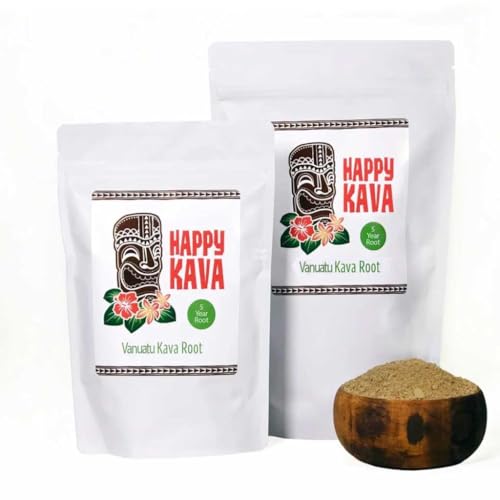
Happy Kava Vanuatu Borogu Kava Root Powder (Noble, 2-4-3 Chemotype)
Happy Kava
The rare bag that prints its cultivar, chemotype, and kavalactone range right on the label.
Our verdict: For buyers who want to know exactly what's in the bag, this is the standout. Happy Kava's Vanuatu Borogu doesn't just say "noble" — it prints the cultivar (Borogu), the chemotype (2-4-3), and a kavalactone range (8–10%) on the listing itself. That level of disclosure is genuinely rare on Amazon, and Borogu is the classic balanced daily cultivar, so you get transparency and a crowd-pleasing profile in one.
Lab report. Best documented label in this guide: the listing states Vanuatu Borogu, noble variety, a 2-4-3 chemotype, and an 8–10% kavalactone range right in the title — far more than most bags disclose. We credit those printed figures; as always, a brand-stated spec isn't the same as a posted third-party batch certificate, so request the current sheet if you want lab paperwork.
Most kava bags tell you almost nothing. This one tells you what it actually is. Happy Kava's Vanuatu Borogu Kava Root Powder states its specifics right on the listing: Borogu cultivar, noble variety, a 2-4-3 chemotype, and an 8–10% kavalactone range. In a category where "noble" is often the only claim on the package, printing the chemotype and a kavalactone figure is a real act of transparency — and the thing serious buyers ask for first.
The caveats are small and honest. A label figure is a brand-stated spec, not a posted third-party batch certificate — Happy Kava is well ahead of the field on disclosure, but if you want lab paperwork, request the current batch sheet. And it's traditional grind, so the strainer bag still applies. For transparency plus a reliable, balanced Borogu, nothing else here matches it.
Who should buy it.
Buy the Happy Kava Borogu if label transparency is your priority — you want the cultivar, chemotype, and kavalactone range printed up front — and you like the idea of Vanuatu's classic balanced daily cultivar.
What we don't like.
The printed 2-4-3 / 8–10% is a brand-stated label spec rather than a posted third-party batch COA, so document-hunters should still request the sheet. The 4 oz size is smaller than the value bag, and it's traditional grind — you strain it.
- Origin
- Vanuatu
- Cultivar
- Borogu (classic balanced daily noble)
- Chemotype
- 2-4-3 (stated on label)
- Kavalactones
- 8–10% range (stated on label)
- Grind
- Traditional — requires straining
What we like.
- Prints cultivar, chemotype (2-4-3) and 8–10% KL on the label
- Borogu — the classic balanced daily noble
- Far more disclosure than the typical bag
- Reliable, crowd-pleasing profile
Worth noting.
- Label spec, not a posted third-party batch COA
- 4 oz size — smaller than the value bag
- Traditional grind — you strain every bowl

Kavafied KAVA Supreme — Noble Vanuatu
Kavafied
A noble Vanuatu powder built to pair with Kavafied's AluBall shaker — the least-messy way to strain.
Our verdict: The most beginner-friendly way to drink real Vanuatu kava. KAVA Supreme is noble Vanuatu powder from Kavafied — the company best known for the AluBall, a shaker-ball that turns the messy knead-and-strain ritual into a shake-and-pour. It's traditional grind at heart, but paired with the AluBall it's the closest the authentic article gets to push-button. A balanced, approachable everyday pour.
Lab report. Stated noble Vanuatu; Kavafied is the maker behind the popular AluBall shaker and sells a finely-prepared noble powder designed for it, though the listing doesn't post a per-batch COA or kavalactone number.
The biggest barrier to traditional Vanuatu kava is the prep — and Kavafied built a fix. KAVA Supreme is a noble Vanuatu powder from the company behind the AluBall shaker: instead of kneading powder in a cloth bag, you load the AluBall, add water, and shake. It still strains real root through a screen — so you're drinking an authentic bowl, not an instant — but the mess and the learning curve mostly disappear.
The trade-offs are modest. It's a balanced, everyday noble rather than a specified all-waka heady cut, so purists chasing a particular profile may prefer Koa; and to get the full convenience benefit you'll want the AluBall, which is a separate buy. But for ease of preparation with no loss of authenticity, nothing else here comes close.
Who should buy it.
Buy KAVA Supreme if you want authentic noble Vanuatu kava but the strain-it ritual has been your sticking point — especially if you'll pair it with Kavafied's AluBall shaker for near-push-button prep.
What we don't like.
It's a balanced everyday noble rather than a specified waka or lawena cut, so profile-chasers get less control, and the full convenience really wants the separate AluBall. Like the others, there's no published per-batch COA or kavalactone number.
- Origin
- Vanuatu (noble)
- Cut
- Balanced noble blend
- Prep
- Traditional grind, optimized for the AluBall shaker
- Best paired with
- Kavafied AluBall (sold separately)
- Transparency
- States noble; no per-batch COA posted
What we like.
- Easiest prep of any pick (with the AluBall)
- Authentic noble Vanuatu root — not instant
- Balanced, approachable everyday profile
- From the team behind the popular AluBall
Worth noting.
- Balanced blend — less profile control than an all-waka
- Full convenience needs the separate AluBall
- No published COA / kavalactone figure
TRU KAVA Whole Root Kava Powder — Ceremonial-Grade Vanuatu
TRU KAVA
A whole-root, ceremonial-grade Vanuatu grind for purists who want the full, traditional bowl.
Our verdict: The traditionalist's pour. TRU KAVA's whole-root powder uses the entire root — lateral and basal together — for a full-bodied, ceremonial-grade bowl rather than a single isolated cut. It's the pick for someone who wants the complete, balanced traditional experience the way it's served at a nakamal, and it comes from a brand that's already a familiar name in the US kava scene.
Lab report. Marketed as ceremonial-grade whole-root noble Vanuatu; TRU KAVA is a recognized US kava brand, and whole-root means the bag carries both the heady (lateral) and the heavier (basal) cuts together — though the listing doesn't post a per-batch certificate of analysis.
"Whole root" is a deliberate choice, and it's what makes this the ceremonial pick. TRU KAVA's Whole Root Kava Powder grinds the entire noble Vanuatu root — the heady lateral waka and the heavier basal lawena together — rather than separating one cut. The result is a fuller, more rounded bowl that drinks closer to how kava is traditionally served at a nakamal, where the whole root goes in.
The trade-offs are honest. Because it includes the basal root, it can drink a touch heavier than an all-waka pick like Koa, so it leans evening rather than midday. And like the rest of the guide it's traditional grind with no posted per-batch COA — you're buying a recognized brand's ceremonial-grade claim. For a purist who wants the whole, balanced Vanuatu root, that's exactly the point.
Who should buy it.
Buy the TRU KAVA whole-root if you want the complete, ceremonial-style traditional bowl — both cuts of the root together for a full, balanced effect — from a familiar US brand, and you lean toward evening pours.
What we don't like.
Whole-root includes the basal cut, so it can drink heavier than an all-waka pick and isn't the one for a bright midday lift. There's no posted per-batch COA, and it's traditional grind — straining required.
- Origin
- Vanuatu (noble)
- Cut
- Whole root (lateral + basal together)
- Grade
- Ceremonial-grade (stated)
- Profile
- Full-bodied, balanced — leans evening
- Grind
- Traditional — requires straining
What we like.
- Whole-root grind — the full traditional bowl
- Balances heady (waka) and heavy (lawena) cuts
- Ceremonial-grade, from a recognized US brand
- Authentic nakamal-style experience
Worth noting.
- Heavier than an all-waka pick — evening pour
- No posted per-batch COA
- Traditional grind — you strain every bowl
More kava worth comparing
Beyond this guide: the highest-rated kava across every format, kavalactones verified, with a live price check on each.




As an Amazon Associate we may earn from qualifying purchases, at no cost to you. 21+.
Quick shop: every pick.
Skip the scroll: the whole lineup, with a live price check on each.
- Koa Kava Vanuatu Waka — Premium Noble (100% Lateral Roots)Best OverallKoa Kava · ~$30–$45Check price
- Wakacon Vanuatu Waka Kava Powder (16 oz)Best ValueWakacon · ~$30–$50 (16 oz)Check price
- Happy Kava Vanuatu Borogu Kava Root Powder (Noble, 2-4-3 Chemotype)Best Transparency / Best BoroguHappy Kava · ~$25–$40 (4 oz)Check price
- Kavafied KAVA Supreme — Noble VanuatuBest for Easy PrepKavafied · ~$25–$40Check price
- TRU KAVA Whole Root Kava Powder — Ceremonial-Grade VanuatuBest Ceremonial GradeTRU KAVA · ~$30–$55Check price
How we chose.
We judged Vanuatu kava on the things that actually separate an authentic noble bowl from a marketing claim: provenance (is it genuinely Vanuatu noble root, and does the brand say which cultivar or part of the root?), cut and chemotype transparency (waka vs. lawena, and whether a chemotype or kavalactone figure is published), prep reality (every pick here is traditional grind, so we weighed how easy each is to strain), and value (cost per bowl, not just sticker price).
We prioritized products genuinely sold on Amazon so you can buy the exact item we reviewed, and we lead each card with the real product photo. Ratings are our editorial scores, not a scrape of star averages. Where a brand publishes a chemotype or kavalactone number we credit it by name; where a brand states "noble" but posts no per-batch certificate of analysis, we say so plainly rather than inventing one.
We make no health claims. Kava is a traditional evening relaxant enjoyed by adults in Vanuatu and across the Pacific; it is not a treatment for any condition, effects vary person to person, and the right amount is the smallest one that does the job.
Questions, answered
Why is Vanuatu considered the home of noble kava?
Vanuatu is the genetic and cultural heartland of Piper methysticum — the islands where the noble cultivars were selected over centuries of daily drinking and where the kava ritual is woven into everyday life. It's also the source of the modern noble-versus-tudei standard: Vanuatu's export rules restrict kava to noble cultivars for daily consumption. When buyers want "the real thing," authentic Vanuatu noble root is what they mean.
What's the difference between waka and lawena?
They're different parts of the same plant. Waka is the thin, lateral roots that branch out from the base — prized for a heady, clear-headed, sociable effect. Lawena is the thicker basal stump, which drinks heavier and more sedating. "Whole root" combines both for a fuller, balanced bowl. Our Koa pick is 100% waka (heady), the TRU KAVA pick is whole-root (balanced, ceremonial), and Borogu is the classic balanced daily cultivar.
Does "from Vanuatu" guarantee it's noble?
Not by itself — but Vanuatu's own export law restricts kava leaving the country to noble cultivars, which is a meaningful safeguard. Still, the spec you actually want on the label is the word "noble" (and ideally a cultivar like Borogu or a chemotype). "Noble, not tudei" is the distinction that matters: tudei ("two-day") cultivars are harsher and not meant for daily drinking. Every pick in this guide is noble Vanuatu kava.
These are traditional grind — do I have to strain them?
Yes. Traditional-grind powders are the authentic article, which means you knead a few tablespoons in warm water inside a strainer bag, then wring out the liquid and drink the cloudy grog. It's a couple of minutes of effort and it's part of the experience. If that's the dealbreaker, our Kavafied KAVA Supreme pick is designed to work with the AluBall shaker, which makes straining real root about as easy as it gets short of an instant.
Which Vanuatu kava should a beginner buy?
For ease, the Kavafied KAVA Supreme paired with an AluBall shaker is the gentlest on-ramp — authentic root with minimal mess. For transparency, the Happy Kava Borogu prints its 2-4-3 chemotype and 8–10% kavalactone range so you know what you're getting. Whichever you choose, start with a modest pour, wait the full 20–30 minutes before adding more, and keep it to the evening.
Is Vanuatu kava safe? Any cautions?
Kava is a traditional adult relaxant, not a medicine, and it isn't a treatment for any condition. Use common sense: choose noble kava (everything here is), start low, keep it to the evening rather than all day, never mix it with alcohol, and be cautious if you take other medications or have liver concerns — talk to a doctor first. This guide is editorial, not medical advice, and it's for adults 21+.