Our Pick: Karuna Kava
Check PriceKaruna Kava Review (2026): The Fresh-Brewed Bottle, Tested
Karuna Kava does something almost nobody in the ready-to-drink lane does: it brews real noble kava fresh, skips the extracts and powders, and ships it cold to your door. The format is a genuine point of difference and the noble sourcing reads right. But on the one number that lets you comparison-shop kava honestly, Karuna goes quiet. Here's the full verdict, with the receipts and the gaps.
By The Kava Review DeskUpdated 2026-06-17~8 min read Ranked by the lab reportHow we researchOfficial site ↗
Almost every ready-to-drink kava on a shelf is built the same way: take a kava extract or a spray-dried powder, dissolve a measured dose into flavored water, can it, and print a kavalactone number on the side. It's shelf-stable, it's consistent, and it tastes like what it is. Karuna Kava, a small zero-proof kava bar in Boise, Idaho, took a different swing. It brews its kava the way a nakamal does — real noble root, traditionally prepared, no extracts and no powders — bottles that fresh brew, keeps it cold, and ships it to your door. As a ready-to-drink concept that is genuinely unusual, and it's the single best reason the brand earns a full deep-dive.
First, the disclosure that governs every review on this site: Karuna Kava did not pay for this review, didn't see it before publication, and had no say in a word of it. We have no affiliate relationship with the brand at the time of writing — we don't earn a commission if you buy, and that wouldn't change a score if we did. What follows comes from Karuna's own shop and product pages, its bar pages, and the same desk standard we apply to every vendor: does it tell you what's in the cup, in writing, with a number you can check? Where Karuna's marketing outruns its paperwork, we say so plainly.
The shape of the review: the format that makes Karuna interesting (a fresh-brewed, no-extract RTD, and why that's rare), the noble multi-island sourcing and the ten-flavor range, the value math at $3.75 a serving, and then the knock — and there is a real one. Karuna leans hard on "traditionally brewed noble kava," but it doesn't publish a certificate of analysis and it doesn't print a kavalactone milligram number anywhere we could find. By our standard, a noble claim with no posted paper and no disclosed number is the weakest rung on the trust ladder — and it stings more in the RTD lane, where the canned competition does print a number. The usual ground rules apply throughout: kava is for adults, it can cause drowsiness, don't drive after drinking it, and if you take medications or are pregnant, talk to your doctor first. None of this is medical advice.
The short version
- Karuna Kava's signature product is a Premium Ready-to-Drink Kava that's brewed fresh from real noble root — "no additives, powders, or extracts" — kept cold and shipped to your door (refrigerate on arrival). In a category dominated by extract-based cans, that fresh-brew approach is the brand's real differentiator.
- Sourcing reads right: traditionally brewed noble kava the brand sources across Vanuatu, Hawaii, Fiji, the Solomon Islands "and beyond." Noble (not tudei) is the right answer to the first question we ask any vendor.
- It comes in ten flavors — from Traditional Vanuatu to Relaxed Chai, Coconut Chai, Pineapple Ginger, Spiced Mint, Watermelon Honeybush and more — at roughly $3.75 per serving (an $11.25 three-serving pack), with a rotating Kava Subscription from about $11.11 a box that ships Mondays.
- The decisive knock: Karuna discloses no kavalactone milligram number per serving and posts no public COA. "Traditionally brewed noble kava" is a sourcing story, not a lab sheet — and in the RTD lane it means you can't comparison-shop strength against a canned brand that prints its number.
- It's a kava-only brand, not a kratom shop: the catalog is the RTD kava, the subscription, a kanna shot, and a fire cider — no kratom anywhere on the site, which keeps the lane clean.
- Buy Karuna for the format — a real fresh-brewed noble kava you can drink without a strainer bag or a powder tin — if extract-based cans leave you cold. Don't buy it expecting a disclosed-potency number; it doesn't give you one.
At a glance
| Product | What it is | Per-serving math | Price |
|---|---|---|---|
| Premium Ready-to-Drink Kava | Fresh-brewed noble kava, no extracts/powders — ships cold, refrigerate on arrival | ~$3.75 / serving | $11.25 (3-serving pack) |
| Kava Subscription | A rotating mix of the brand's best varieties, shipped Mondays | varies by cadence | from ~$11.11 / box (weekly) |
| Blueberry Mojito Kanna Shots | A kanna (Sceletium) shot — a separate botanical, not kava | single shot | $8.95 |
| Kava Lava Fire Cider 16oz | An organic wellness tonic (32 servings) — kava-adjacent pantry item | n/a | $24.95 |
The Karuna Kava range at a glance — prices and formats verified June 2026 (the shop lists both a sale and a regular price; sale prices shown). The RTD kava is the same fresh-brewed noble base across flavors; the line differs by flavor, not by any disclosed potency number.
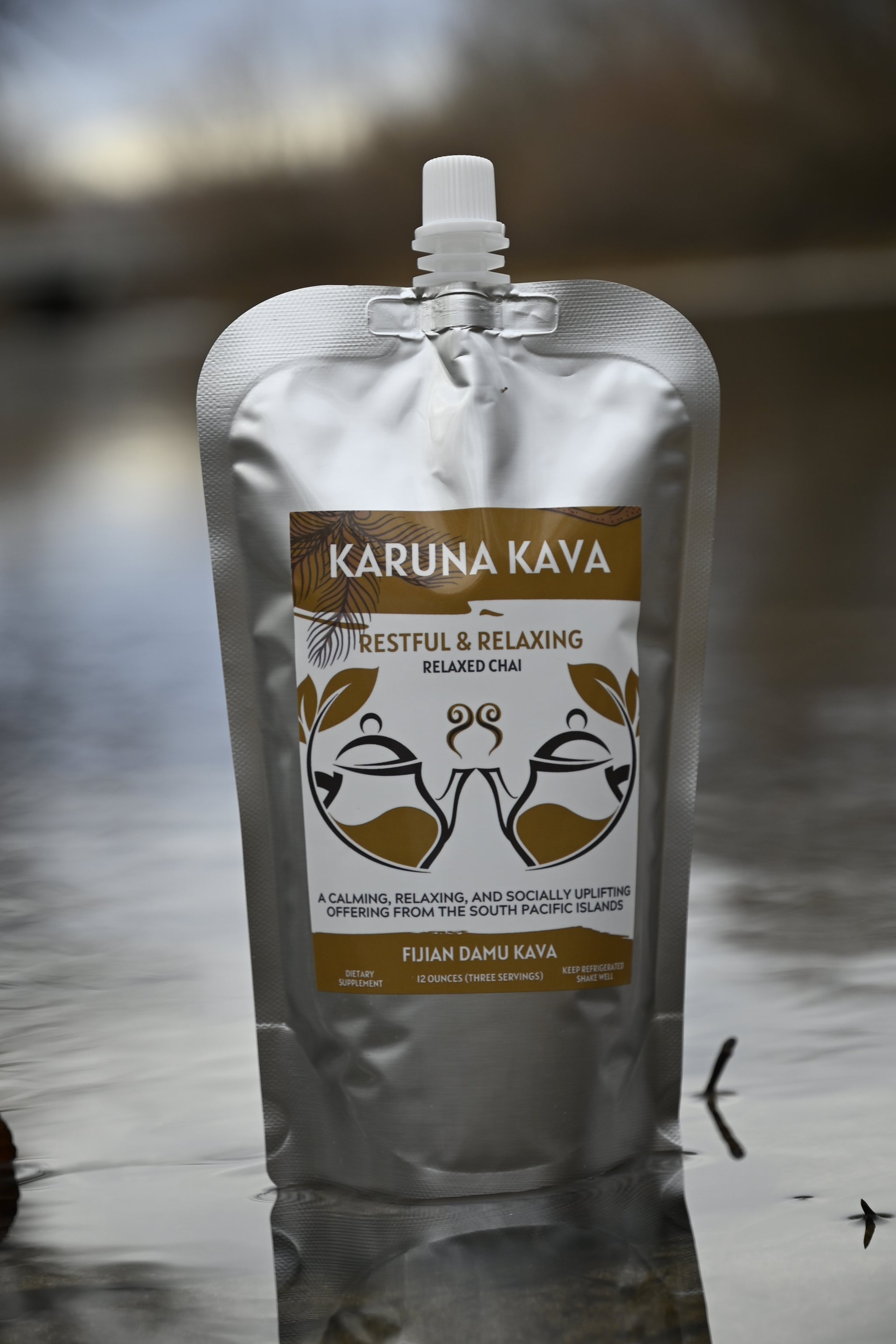
Karuna Kava Premium Ready-to-Drink Kava
Karuna Kava
A real fresh-brewed noble kava you drink straight from the bottle — the rare extract-free RTD, with one disclosure gap.
Our verdict: Karuna's Ready-to-Drink Kava is the rare RTD that isn't built on an extract: it's real noble kava, brewed fresh, kept cold, and shipped to drink straight. The no-powder, no-extract approach is a genuine point of difference in a canned category that mostly reconstitutes a dose, the noble multi-island sourcing is the right answer, and ten flavors give you room to find your lane. We rate the format highly and the transparency middling: the brand calls its kava noble and traditionally brewed but posts no certificate and prints no kavalactone number, so you're buying on freshness and trust, not a checkable potency figure.
Lab report: Marketed as traditionally brewed noble kava sourced across Vanuatu, Hawaii, Fiji and the Solomon Islands, with "no additives, powders, or extracts." But no published COA library and no disclosed kavalactone milligram number — noble sourcing asserted, not documented on paper.
The product is the brewing method, and the method is genuinely unusual. Almost every ready-to-drink kava you can buy starts from a kava extract or a spray-dried powder that's measured into flavored water. Karuna's Premium Ready-to-Drink Kava goes the other way: it's brewed fresh from real noble root the way a kava bar prepares a shell — the brand is explicit that there are "no additives, powders, or extracts" — then bottled, kept cold, and shipped to you to refrigerate and drink. If the appeal of kava for you is the real, traditionally prepared drink rather than a reconstituted dose, this is the most direct version of that we've seen arrive in the mail.
The sourcing answers our first question correctly. Karuna describes its kava as noble — the smoother everyday-drinking cultivars, not the rougher tudei varieties we tell readers to avoid — sourced across Vanuatu, Hawaii, Fiji, the Solomon Islands and beyond. The line spans ten flavors, from a plainer Traditional Vanuatu to dressed-up profiles like Relaxed Chai, Coconut Chai, Pineapple Ginger, Spiced Mint and Watermelon Honeybush, all built on the same fresh-brewed noble base. Karuna also sells a rotating Kava Subscription and a couple of adjacent items — a kanna shot and a fire cider — but the RTD kava is the heart of it.
As a drinking experience, a fresh-brewed noble kava behaves the way you'd expect: the signature brief tongue-tingle that marks real kavalactones, then an easy, social ease that builds over a serving or two. The flavor work is the point of the ten-SKU range — the dressed-up profiles are there to make a famously earthy drink approachable. Value-wise, about $3.75 a serving on the RTD pack is reasonable for fresh-brewed kava that ships cold, and the subscription shaves a little off if you settle on it. None of those prices are unreasonable — they just buy you freshness and sourcing, not a disclosed potency figure.
Who should buy it
Buy Karuna's Ready-to-Drink Kava if the appeal of kava is the real, traditionally brewed drink and extract-based cans have left you flat — this is about as close as a shipped RTD gets to a fresh nakamal pour, with ten flavors to ease past the earthiness and a subscription if you land on a favorite. It's also a sensible introduction for someone who's only had kava at a bar and wants the same kind of fresh-brewed drink at home without owning a strainer bag or a powder tin.
What we don't like
The disclosure gap is the headline knock: "traditionally brewed noble kava" with no published COA and no kavalactone milligram number means you can't verify or comparison-shop the strength — you're trusting the brand's word, and in the RTD lane the canned competition prints a number you can check. The fresh-brewed format also has real-world costs the extract cans don't: it ships cold and must be refrigerated, so it's less grab-and-go and less shelf-stable, and the freshness premium is part of what you're paying for.
- What it is
- Ready-to-drink kava brewed fresh from real noble root — "no additives, powders, or extracts"; ships cold, refrigerate on arrival
- Sourcing
- Noble kava sourced across Vanuatu, Hawaii, Fiji and the Solomon Islands (noble, not tudei)
- Flavors
- Ten — incl. Traditional Vanuatu, Relaxed Chai, Coconut Chai, Pineapple Ginger, Spiced Mint, Watermelon Honeybush
- Kavalactones disclosed
- None published — noble sourcing claimed, no posted COA, no mg number
- Per-serving price
- ~$3.75 on the $11.25 three-serving pack; a little less on subscription
- Format
- Fresh-brewed liquid, shipped cold — not a shelf-stable can
What we like
- Fresh-brewed from real noble root — no extracts, no powders, unusual for an RTD
- Noble multi-island sourcing, the right answer on the first question
- Ten flavors to ease past kava's earthiness
- Kava-only catalog (no kratom); backed by a real Boise kava bar; ships nationwide
Worth noting
- No published COA and no disclosed kavalactone milligram number — noble sourcing is asserted, not documented
- Ships cold and needs refrigeration — less grab-and-go and less shelf-stable than extract cans, at a freshness premium
More kava worth comparing
Beyond this guide: the highest-rated kava across every format, kavalactones verified, with a live price check on each.




As an Amazon Associate we may earn from qualifying purchases, at no cost to you. 21+.
How we chose
We hold a brand review to the same standard as a category roundup, just deeper. For Karuna Kava that meant verifying every claim we score it on: that the Premium Ready-to-Drink Kava is brewed fresh from real noble root with no extracts or powders, that the sourcing is noble and multi-island (Vanuatu, Hawaii, Fiji, the Solomon Islands), that it ships cold and is meant to be refrigerated, and the live prices and formats — the $11.25 three-serving RTD pack stated at "$3.75 per serving," the Kava Subscription from about $11.11 a box that ships Mondays, and the kanna shot and fire cider that round out the catalog — all read off the brand's own shop in June 2026. We also confirmed Karuna runs a physical zero-proof kava bar in the Boise area and that the entire catalog is kava-and-botanical, with no kratom listed anywhere, which is relevant context for a brand that began behind a bar.
Our signature metric is cost per disclosed kavalactone milligram — per-serving price divided by the kavalactones the brand states. We could not compute it for Karuna, because Karuna discloses no kavalactone number. So we did the next-best honest thing and used the brand's own "per serving" math: about $3.75 a serving on the RTD pack. That tells you what a serving costs; it cannot tell you what a serving delivers. We flag that gap rather than paper over it, and we audit the paper trail the same way we do for every vendor: does the brand post COAs publicly, provide them on request, or merely describe its kava as noble and traditionally brewed? Karuna's posture is story-forward and paper-light — noble sourcing asserted, certificates not published, no milligram number printed.
What we never do: invent lab results, fabricate tasting panels, or make health claims. Where we describe how a fresh-brewed kava drinks, we synthesize the brand's own descriptions and the consistent themes in how traditionally brewed noble kava behaves — the characteristic brief tongue-tingle of real kavalactones, then an easy, social calm — in plain experiential terms. Kava is a centuries-old Pacific social drink, not a treatment for anything; it can cause drowsiness, and anyone on medications should talk to a doctor before pouring one. General caution, not medical advice.
Key terms
- Fresh-brewed kava
- Karuna's approach: real noble kava root prepared into a drink the way a kava bar brews a shell, then bottled and shipped cold — "no additives, powders, or extracts." It's the opposite of the extract- or instant-powder base most shelf-stable RTD cans are built on, and it's why the product must be refrigerated rather than stored on a shelf.
- Noble kava
- The traditional cultivars Pacific growers raise for everyday drinking, prized for a smoother, more agreeable profile than the rougher tudei varieties. Karuna sources noble kava across Vanuatu, Hawaii, Fiji and the Solomon Islands — the right answer to the first question we ask any vendor.
- Kavalactones
- The active compounds in kava root and the entire functional point of a kava drink. A disclosed kavalactone milligram count is to kava what ABV is to beer — the number that makes honest comparison possible. Karuna does not disclose a kavalactone number per serving.
- COA (Certificate of Analysis)
- A lab document reporting what's actually in a batch. The trust ladder: posted publicly per batch (best), available on request (acceptable), "it's noble, traditionally brewed" with no documents (a claim, not evidence). Karuna currently sits on the bottom rung — our biggest knock on an otherwise well-sourced product.
- Cost per serving
- The honest value metric we fall back to when a brand discloses no kavalactone number. From Karuna's own per-serving math, the RTD runs about $3.75 a serving. It tells you what a serving costs — not what a serving delivers.
- Kanna
- Sceletium tortuosum, a South African succulent sold as a mood-lift botanical — a different plant from kava. Karuna sells a Blueberry Mojito kanna shot alongside its kava; we mention it only to be clear which products on the menu are kava and which aren't.
Questions, answered
What is Karuna Kava's Ready-to-Drink Kava, exactly?
It's a fresh-brewed kava drink. Karuna prepares real noble kava root into a beverage the way a kava bar brews a shell — explicitly with "no additives, powders, or extracts" — then bottles it, keeps it cold, and ships it for you to refrigerate and drink. That sets it apart from most ready-to-drink kava, which is built from an extract or instant powder. It comes in ten flavors, from a plain Traditional Vanuatu to dressed-up profiles like Relaxed Chai and Coconut Chai.
Is Karuna Kava real kava, and is it noble?
Yes on both counts, per the brand. Karuna describes its kava as traditionally brewed from 100% real noble root — not an extract, not a synthetic — sourced across Vanuatu, Hawaii, Fiji and the Solomon Islands. Noble (rather than tudei) is the variety class we tell readers to look for, so on sourcing the brand passes our first check. The one thing it doesn't give you is a lab document confirming it, which is our main knock.
How many kavalactones are in Karuna Kava?
Karuna doesn't say. The brand describes its kava as noble and traditionally brewed, but it doesn't publish a certificate of analysis and prints no kavalactone milligram number per serving anywhere we could find. That's our main knock: a noble claim with no posted paper and no disclosed number sits on the bottom rung of our transparency ladder, and in the ready-to-drink lane it means you can't comparison-shop the strength the way you can with a canned brand that prints its number.
How much does Karuna Kava cost per serving?
Because there's no disclosed kavalactone number, we price it per serving from the brand's own math. The Premium Ready-to-Drink Kava is sold as an $11.25 three-serving pack stated at "$3.75 per serving." The rotating Kava Subscription runs a little less per box (from about $11.11 weekly, $11.23 bi-weekly, or $11.35 monthly) and ships Mondays. Those numbers tell you what a serving costs, not what it delivers.
Does Karuna Kava sell kratom?
No. Karuna's catalog is kava-and-botanical: the fresh-brewed Ready-to-Drink Kava, the Kava Subscription, a kanna (Sceletium) shot, and a fire cider tonic. We found no kratom listed anywhere on the site. We always draw that line clearly because kava and kratom are different plants with different effects and legal pictures — Karuna keeps its lane clean on this front.
How does Karuna Kava compare to a canned kava like MELO?
They're different formats solving different problems. MELO is a shelf-stable can built from a measured kava dose that prints 100 mg of kavalactones on the label, so you can compute cost-per-milligram and comparison-shop its strength. Karuna is a fresh-brewed, extract-free kava that ships cold and tastes closer to a kava-bar pour — but it discloses no kavalactone number and must be refrigerated. If transparency or grab-and-go convenience is your priority, MELO's printed number and shelf-stable can win; if a real, fresh-brewed noble kava is what you're after, Karuna's format is the better tool.
Is Karuna Kava safe to drink?
Kava has been consumed socially across the Pacific for centuries, and Karuna uses noble cultivars — the traditional everyday-drinking varieties. For most adults that's a mild, mellow, social experience. But we're reviewers, not doctors: kava can cause drowsiness, so don't drive after a serving; don't mix it with alcohol; skip it during pregnancy or nursing; and if you take medications or have liver concerns, talk with your doctor first. This is general caution, not medical advice.
Did Karuna Kava pay for this review?
No. This review is independent and unpaid. Kava Review has no affiliate relationship with Karuna Kava at publication — we don't earn a commission if you buy, and nobody at the company reviewed this before it ran. Every fact here was verified against Karuna's own shop, product pages and bar pages in June 2026, and our scoring would be the same with or without a commission.
Keep reading
The Best Kava Drinks (2026)
Every major canned and ready-to-drink kava, priced per 100 mg of kavalactones where the brand discloses one.
What Is a Kava Bar?
How the nakamal works, what to order, and why brands like Karuna started behind a bar.
What Are Kavalactones?
The active compounds in kava — and why a disclosed milligram number is the one figure that matters.
The Best Kava Brands (2026)
Our master ranking of kava vendors, judged first and hardest on transparency.